Windows desktop · 15-day trial

From keyword to published post in one window.

SEO Content Architect reads the pages already ranking for your keyword, writes the article against what it finds, generates the images, and sends the whole thing to WordPress with the meta title and description already in place. Then it audits the site, tracks the position and tells you what to fix next. It runs on your own machine, on your own API keys.

No card required  /  All features unlocked during the trial  /  Article generation stays free afterwards

50
Publishing languages, with localisation rather than translation
30+
Article types, each with its own structure rather than one template
26
Technical checks in the site audit, crawled from your own connection
0
Drafts, keys or site credentials stored off your machine
SEO Content Architect brand banner: the SCA monogram beside a robot wearing headphones, with the words Content Intelligence.
Content intelligence

The research step runs before the writing step, not after it.

What it does

Seven jobs that usually need seven tools.

Research, drafting, images, metadata, publishing, repurposing and distribution sit in one window, with the keyword research, auditing and rank tracking further down the page. Nothing leaves your computer except the article you decide to publish.

Bring your own API keys

SEO analysis before a word is written

Give it a keyword and it crawls the pages currently ranking for it. You get the word count the winners are hitting, the terms they all cover, the questions people also ask, and how many headings and images they use. Those numbers become the brief the writer works to.

Live SERP data

Drafting you can take apart

Point it at a keyword, a URL or a topic and it returns a full article built on the outline. Every section is a block, so you can regenerate one paragraph without rewriting the piece around it. Choose Gemini, GPT or Claude directly, or connect OpenRouter and pick from every text model on its platform, one per task.

Gemini · GPT · Claude · OpenRouter

Images in the editor

Featured image and in-article visuals, generated where you are writing. Eight sources to pick from, per article or per site, including Pexels photography when a real photograph beats a generated one.

8 image sources

WordPress publishing

Connect your sites once over the REST API, then publish, hold as a draft or schedule, with categories, images, SEO metadata and structured data already attached. Republishing a refresh keeps the original URL.

Unlimited sites

Write where you publish

Fifty languages, with headings, body, meta and FAQ produced in the target language and the keywords kept in it rather than translated back to English.

50 languages

Topics pulled from live feeds

RSS, Google News, NewsAPI, TheNewsAPI, Bing News, GitHub Trending, Hugging Face, a trend index, a Perplexity Sonar feed or your own JSON endpoint. Anything already turned into an article is flagged, so the same story is never written twice when two feeds carry it.

10 source types

Nothing sits on someone else's server

The app is installed, not hosted. Drafts, API keys and site credentials stay on your disk, which also means your keyword strategy is not sitting in a vendor's database.

Zero cloud storage

Before you press generate

A brief is more than a keyword and a word count.

A buying guide and a fact-check are not the same document, so the shape is chosen before anything is written rather than fixed for you. Each category changes the structure, the depth and the default tone.

5 categories
News, products, educational, business and tech, general
30+ types
Fact-check, comparison, buying guide, case study, roundup
9 tones
Professional through to humorous
3 lengths
Roughly 1,500, 2,500 or 4,000 words, as a target

What it reads first

  • The topic is researched on the live web, so prices and versions are not taken from stale training data
  • A slower fact-check pass for pieces where being wrong is expensive
  • Paste URLs and each page arrives as its own labelled source, so the model compares rather than blurs
  • Duplicate content and title similarity checked against what you have already published

Your standing rules

  • Intended audience and extra context, so vocabulary and examples match who is reading
  • Custom instructions applied to everything you produce: banned words, required sections, the call to action
  • High Quality Mode adds a second editorial pass that tightens the wording and cuts repetition
  • A different model per task, rather than one model for the whole pipeline

What comes back

  • Structured HTML with an FAQ section, meta title and meta description
  • Internal links to posts you already have, drawn from your own crawled pages
  • Relevant YouTube videos found and placed where they belong in the body
  • Article, Breadcrumb, Product and Review schema, the last two built only from figures you enter yourself

Where the pictures come from

Nano Banana 2 DALL·E 3 Pexels Flux 2 Pro P-Image on Replicate Wan 2.7 MAI Image 2.5 Any OpenRouter image model

Set the source per article or per site, and decide how many visuals a piece carries; they are inserted at sensible points with alt text. Visual Studio edits what an article already has or generates more, and an existing image can be used as a visual reference so a set stays consistent. Stock and generated images mix freely.

Inside the app

A live score against the pages you're trying to beat.

The Studio Editor grades every draft against the results currently ranking for your keyword — recommended terms, length, heading structure, People Also Ask and images — and shows exactly what is still missing before you publish.

SEO Content Architect — Studio Editor — draft

Workspace

  • My Articles
  • New Article
  • SEO Analysis
  • Social Studio
  • Distribution
  • Auto Posting
  • Bulk Engine
  • Settings

Studio editor

2,180 words 14,900 chars 9 min read Readability fair (58)
  • H1

    How to Choose an AI Content Writer in 2026

  • H2

    What an AI content writer actually does

  • H3 · writing

    Matching tone to the posts you already publish

  • H2

    A checklist before you hit publish

Content score

82 Strong vs SERP for “ai content writer”
Recommended terms33 / 40

24 / 30 terms at target frequency

Word count18 / 20

2,180 words vs median 2,100

Heading structure13 / 15

18 headings (7 H2 + 11 H3) vs ~20

PAA questions12 / 15

4 / 5 questions answered

Images6 / 10

4 images vs ~6

Interface representation. Score and targets shown are an example run against a live SERP.

Editing

  • Headings, lists, quotes, highlights, links and tables with header rows
  • Type / to drop in a block without leaving the keyboard
  • Edit, preview and raw HTML, for when markup needs fixing by hand
  • Readability recalculated as you type, easy through to hard

Titles and metadata

  • Meta title and description written by the AI, fully editable, one click to regenerate
  • Both pushed into your own SEO plugin's fields when the article publishes
  • Five title options that, with Search Console connected, aim at the gap between your real click-through rate and the expected one

Links, images and drafts

  • Internal link suggestions from your own crawled pages, with orphan and under-linked pages ranked higher
  • Anchor text is only chosen where it already exists in your draft, and any insertion can be undone
  • An image library to reuse, with one marked as the WordPress featured image
  • Local drafts keep images, meta and schema, so a half-finished piece waits for you
SEO Content Architect banner: a mechanical brain built from buildings, documents and charts, labelled AI Content Builder, SEO Optimized.
AI content builder

One article in, a week of posts out.

Research and measurement

Everything either side of the writing.

The same window that writes the article also decides what to write next, watches what happened to the last one, and crawls the site it went on. All of it runs on your own keys, and the history stays in a local database rather than expiring with a subscription.

Keyword research

One seed keyword becomes a full list with search volume, CPC, difficulty and search intent, grouped into topic clusters. Discovery and measurement happen in the same call, so a research run does not turn into a stack of separate charges. Grouping by page then turns the list into clusters that belong on one article, each with a working title and a proposed slug.

CSV export

Site Explorer

Scan any domain, yours or a competitor's, and see every keyword it ranks for, split into position bands and aggregated per page. Compare two scans of the same domain and the gained and lost keywords come out as one table, which is a competitor's content strategy in plain sight.

4 position bands

Content Gap

Your domain against up to three competitors, showing the keywords and topics they rank for and you do not, clustered and scored by priority. One button sends an entire cluster to the Bulk Engine. Competitor discovery finds the domains that genuinely compete for your keywords rather than the ones you assumed.

Into the Bulk Engine

Search Console insights

Five reports on your own Search Console data, connected through your Google account with read-only access: opportunities scored across eight weighted factors, queries sitting at positions five to twenty, pages whose clicks are falling, one query split across two of your own pages, and pages earning fewer clicks than their position should produce. Every row comes with the action it needs.

5 reports

Rank tracker

Positions over time, checked by hand or on a schedule and linked to the article targeting each keyword. A position that is not found is recorded as not found rather than as zero, and never ranked, dropped out and blocked are reported as three different things. Stagnation detection flags keywords that have stopped improving and prepares a refresh brief for the article behind them.

Local history

Site audit

Twenty-six technical checks crawled from your own connection and your own IP, which is why the pages come back at all: a cloud crawler gets blocked by bot protection where a request from your machine looks like a visitor. Titles, H1s, thin content, canonicals, accidental noindex, alt text, redirect chains, broken links and orphan pages, each with a severity, a fix and an estimated time.

500 pages per run
AI visibility

Whether the models recommend you at all

An increasing share of the answer happens outside Google. Your prompts run across several models with web search on, and the report says how often your brand is mentioned, how that compares with your competitors, and which model said what.

Mention rate
Per model, and combined
Share of voice
Against named competitors
Prompt gaps
Each with a write-article button
Cited page gap
Plain HTTP, so it costs nothing
  • A trend line per brand, where a scan that returned nothing breaks the line instead of drawing a zero
  • Points are marked on the chart when the prompt set changed
  • Weekly scans are optional and off by default, with the estimated cost shown before you commit
Reports

Something you can hand to a client unedited

Site Explorer, Content Gap and Site Audit each export as a single HTML file with no external fonts, scripts or CDN calls, so it opens on any machine and survives being emailed. Nothing in it is communicated by colour alone.

One file
No external requests at all
Provenance footer
Endpoints, rows, runtime, real cost
CSV on every table
The whole report, not the visible rows
Colour-blind safe
Meaning never carried by hue
  • Measured and estimated costs are spelled out separately, never averaged into one comfortable number
  • A closing section on what the numbers do not say, including limits hit and whether the crawl finished
  • CSV carries a UTF-8 marker so Excel keeps your accents, and formula-leading cells are neutralised
  • The three next actions are ranked by the deterministic reports; the model only phrases what the data already ordered
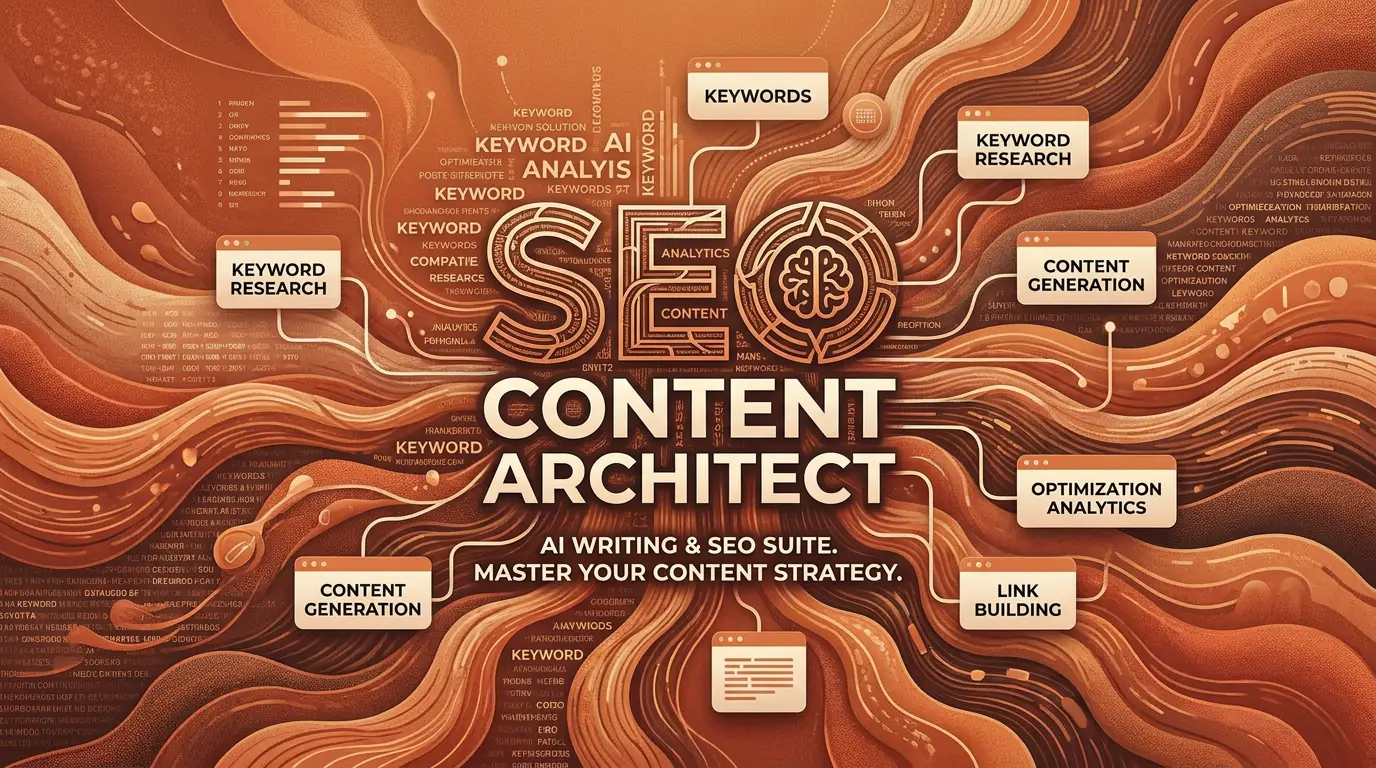
SEO Content Architect banner: the product name at the centre of a keyword map, ringed by cards reading keyword research, content generation, optimization analytics and link building.
AI writing & SEO suite

Research, drafting and optimisation in one place.

Two modules

The article is the start of the work, not the end of it.

Social Studio turns a finished piece into slides or video. Distribution puts the result on up to fifteen platforms and keeps the calendar.

Social Studio

Carousels and short video, from the same source

Feed it a finished article, a URL or just a topic. It researches the subject against live sources first, so the slides say something specific instead of restating the headline four times.

3 sources
Article, URL or topic
16 palettes
Colour themes
4 formats
Portrait, square, story, landscape
MP4 export
Music and nine transitions
  • The app plans the slides and writes each one; you add, remove, reorder and rewrite with a live preview
  • Brand presets for name, handle, logo and colours, so a month of posts looks like one brand
  • Caption, hashtags and first comment written alongside
  • Every project saved with its slides, assets and rendered video, so it reopens months later instead of being rebuilt
Distribution

Fifteen platforms in a single pass

Connect each account once, write the post or let the app draft it from a topic, an article or a saved carousel, then publish straight away or drop it on the calendar. Instagram, TikTok, X, Facebook, LinkedIn, YouTube, Threads, Pinterest, Reddit, Bluesky, Telegram, Discord, Snapchat, WhatsApp and Google Business.

15 platforms
Instagram, TikTok, X and twelve more
Per-platform copy
Rewritten, not copy-pasted
Calendar
The plan as a month view
Analytics
Every platform, one table
  • OAuth only, so passwords are never stored
  • Live character counts against each platform's own limit
  • A thread builder where the platform supports threads, with numbering and per-post limits handled
  • First comment scheduled separately, for the networks that penalise a link in the caption
  • Views, reach, impressions and engagement pulled back into one dashboard

Running it at volume

The parts that matter once one article becomes forty.

Batches, schedules, an interface for your coding assistant, a bill you can read, and a copy of everything that survives a new machine.

Bulk Engine

Paste a list of titles, or send a whole cluster over from Content Gap, and the articles are generated one after another. Sequential rather than parallel, which keeps you inside provider rate limits and the cost predictable. Keywords, images, deep research and custom instructions are set once for the batch.

One queue, one setup

Auto Posting

The app finds the topics, writes the articles with their images and publishes them in the background, whether or not the window is open. The cadence is built exactly: minutes, hours, days of the week, days of the month, months. The next run is always on screen, and Process now empties the queue immediately.

Unattended

Cross-posting and sync

Dev.to gets the article as Markdown with the tags mapped and the canonical URL pointed back at your own site, so the copy does not compete with the original. Pulling your existing WordPress posts into the app makes them visible to internal linking, rank tracking and the duplicate check.

Canonical back to you

Local MCP server

Twelve tools that let Claude Code, Claude Desktop or VS Code drive the app directly: list and read articles, generate one, list your sites, publish, run a SERP analysis, score a draft, fetch keyword metrics, pull a Search Console report, read the rank overview and the site audit, check usage. No separate Node install, ready-made configuration per client, and the access token is rotated at every start.

12 tools

A bill you can read

The usage meter shows what you have spent this month and before it, broken down by provider and by operation, from generation and editorial passes to SERP calls, rank checks and visibility scans. Measured and estimated figures stay visibly apart. Paid actions show their estimated cost first, taken from the median of your own history rather than a list price.

Cost before you click

Backup and restore

The whole application state — articles, sites, settings and history — goes into a single JSON file, with or without the media, and comes back in one click. Backups can be scheduled to a local folder, so a reinstall or a new machine stops being a data-loss event.

One file, one click

The keys you bring

Google Gemini OpenAI Anthropic Claude OpenRouter Serper DataForSEO Moz

Four for the writing and three for the SEO data, two of those with a free tier and one of the two needing no card at all. Each field explains what that provider is used for, what it costs and where it falls short, including which markets return no search volume at all. Settings are split into eight sections with a search box across all of them.

Free WordPress plugin

One free plugin. It writes, it pairs, and it opens the SEO fields.

Diflowrin AI Content Generation installs from the WordPress plugin directory. On its own it turns a keyword, or just a link, into a finished draft using your own OpenRouter key. It also registers the meta title and description your SEO plugin already manages with the REST API, which WordPress keeps closed by default, so the desktop app can fill them in as it publishes.

Diflowrin AI Content Generation

Version 1.2.0  ·  GPL v2  ·  WordPress 5.6–7.0.4  ·  PHP 7.4+

  • Free on WordPress.org, with no licence key and no credits to buy
  • One OpenRouter key of your own covers Claude, Gemini, GPT and the rest
  • Perplexity Sonar researches the topic on the live web before a word is written
  • Paste a link on its own and get an original article written about that page
  • A featured image and up to four illustrations, AI-generated or Pexels photographs
  • Writes in 50 languages, the same list as the desktop app
  • Yoast, SiteSEO, SEOPress and Rank Math meta opened to the REST API
  • Optional notice telling readers the article was written with AI

What it does without the app

Everything above: research, writing, images and SEO meta, driven by your own key with nothing to subscribe to. Bulk generation, scheduling across several sites, rank tracking and Social Studio stay in the desktop app, which is what the Connect button is for.

Install in three steps

  1. Install it

    Search for it on the Plugins screen, or upload the ZIP from WordPress.org.

    wp-admin/plugin-install.php
  2. Add your OpenRouter key

    One key covers Claude, Gemini, GPT and the other models on OpenRouter. The same screen decides whether pictures are generated by a model or taken from Pexels. From here you can already write articles without leaving WordPress.

    AI Content Settings
  3. Press Connect

    Optional, and only for the desktop app. Open the app once, then pair the two with a WordPress application password, which the plugin never stores.

    AI Content Connect

    The button works when the app is installed on the same computer, and WordPress requires HTTPS for it.

Works with the SEO plugin you already run

Yoast SEO SiteSEO SEOPress Rank Math

It does not replace any of them. WordPress keeps SEO meta fields out of its REST API by default, which is why so many publishing tools drop you back into the admin to paste a meta description by hand. The plugin registers the fields your SEO plugin already provides, and only for people allowed to edit that post, so the title and description travel with the article.

Downloads from WordPress.org

291

Daily installs read straight from the WordPress.org plugin API, over the window it returns. The plugin has been in the directory since 23 July 2026.

43
Busiest day, 1 August 2026
13
Average day over the period
1.2.0
Current release, 8 August 2026
23
Days of figures returned
23 Jul 14 Aug

Recorded runs

Watch it work before you install anything.

Three sessions recorded end to end: what the app still does once the trial is over, what a full article actually costs on a cheap model, and an article turned into social content.

All three open on YouTube · diflowrin

Getting started

Three ways in, and one of them never expires.

The app is bring-your-own-key, so what you spend per article depends on the models you point it at rather than a tier someone else picked. A cheap setup runs to a few cents; a premium one lands nearer a dollar or two.

Forever

Free

$0

What the app keeps doing with no licence at all.

  • Unlimited article generation and editing
  • Studio Editor, Content Score and JSON-LD schema
  • Export the article and import it to WordPress by hand
Download it
15 days

Trial

Free

Starts on first install. No card taken.

  • Everything in Free, plus one connected site
  • One-click publishing straight into WordPress
  • Enough to test a real publish end to end

When the fifteen days are up the app does not stop working. Article generation and editing stay unlimited and free; publishing is the part that needs a licence.

Start the trial

Licence pricing

Two lengths, same app behind them.

A licence only covers WordPress auto-posting and the bulk side of the app. Article generation stays free either way, and you keep paying your own AI provider for what you generate.

Starter

30-day licence

$5.99

Valid for 30 days. Good for testing a real workflow.

  • Full desktop access
  • Unlimited articles
  • All features included
  • 30-day validity
Buy now

Questions

Before you download.

What do I need to run it?

A Windows machine. The app is distributed through the Microsoft Store, and it installs locally rather than running in a browser tab.

What does bring-your-own-key mean for the cost?

You connect your own model providers, so you pay them directly and choose the text and image models per job. The same pipeline can produce an article for a few cents or for a dollar or two, depending entirely on which models you point it at.

What happens when the fifteen days are up?

Article generation stays unlimited and free. WordPress auto-posting is the part that needs a licence after the trial, and you can still upload articles to your site by hand in the meantime.

Do I still need Yoast or Rank Math?

Yes, and the free plugin does not try to replace them. It exposes the meta fields your existing SEO plugin already manages so the app can fill them over the REST API. Yoast SEO, SiteSEO, SEOPress and Rank Math are all supported.

Which AI models can I use?

Google Gemini, OpenAI GPT and Anthropic Claude connect directly, and OpenRouter opens every text model on its platform, so Llama, Mistral, DeepSeek, Qwen and the rest are all reachable through one key. The model is chosen per task rather than once for the whole pipeline, which is how a cheap model can draft while a stronger one does the editorial pass.

Where do my drafts and API keys live?

On your own disk. Articles, history, audits, rankings and keyword research sit in a local database, so nothing expires because a subscription lapsed. The only data that leaves your computer goes to the API providers whose keys you entered. Scheduling and background jobs run on a local backend rather than a server of ours.

Can I drive it from Claude Code or VS Code?

Yes. The app runs a local MCP server with twelve tools, so Claude Code, Claude Desktop or VS Code can list and read articles, generate one, publish to a site, run a SERP analysis, score a draft or pull a Search Console report. Nothing extra to install, ready-made configuration per client, and the access token is rotated every time the app starts.

Do I have to pay for SEO data too?

Not to start. Serper covers SERP data on a free tier and Moz gives on-demand search volume without a card; DataForSEO is the paid one, and it is what backs volume, difficulty, ranked keywords and competitor domains. Each field in Settings says what the provider is used for and where it has no data, including the markets that return no volume at all.

How many sites can I connect?

One during the trial, so you can test a real publish end to end. The licensed app removes the limit and adds bulk operations across sites.

Install it and run one article end to end.

Fifteen days, every feature, no card. If the first article does not come out better than what you would have briefed by hand, you have lost an afternoon.

Native Windows application · Electron, React, TypeScript and Vite, with a local Node.js backend for scheduling, backups and crawling