DiFlowRin Research Bibliography Checker

Free WordPress plugin

A reference checker for your visitors

Add one block to a page. Students paste their bibliography and see, within seconds, which sources exist, which have wrong details and which could not be found. No accounts, nothing stored on your site.

Free  ·  No account  ·  No limits  ·  Nothing stored on your site

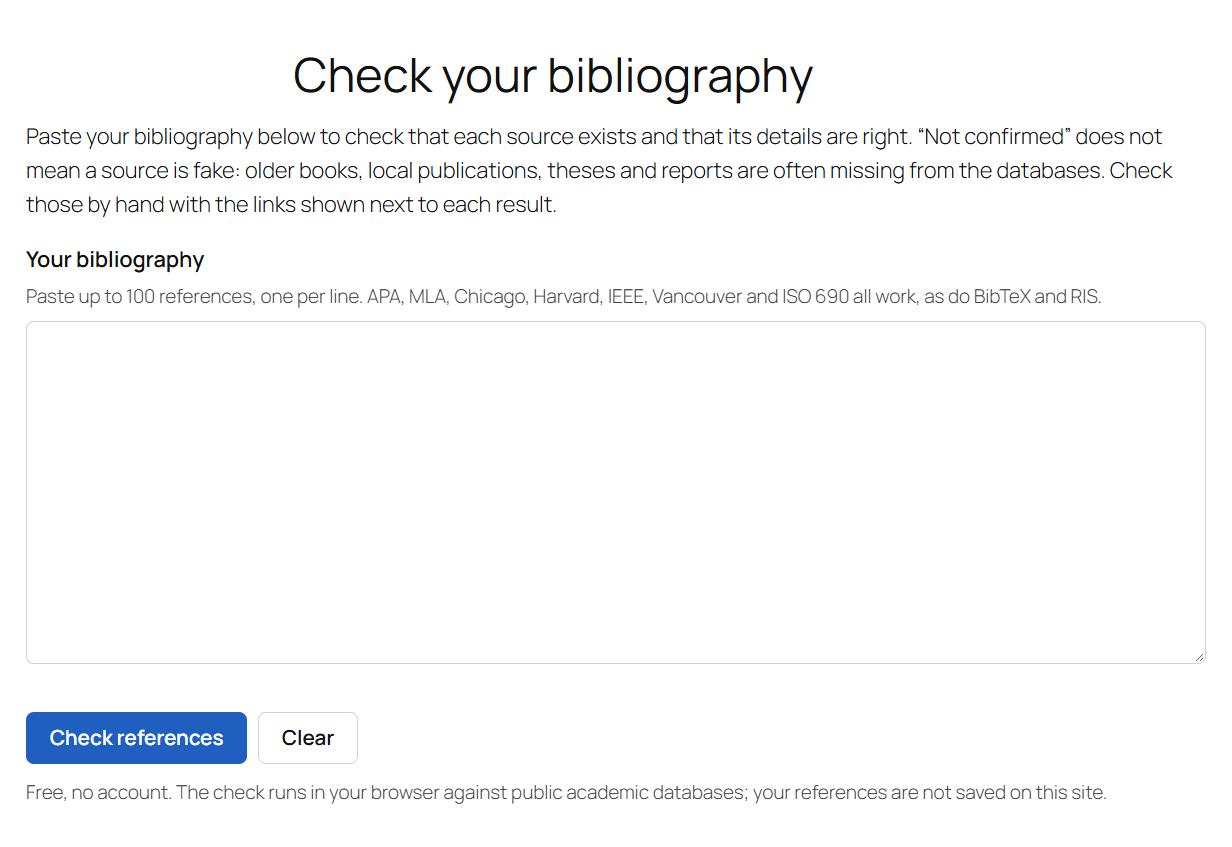
The DiFlowRin Bibliography Checker form on a WordPress page: an introduction, a box for pasting references and a Check references button.

Give students a way to catch invented references

AI tools write references with real-sounding titles, journals and authors for papers that were never published. Checking each one by hand means searching several databases per source. This plugin puts that search on your own site, in a form anyone can use.

University and school libraries Writing centers and doctoral schools Teachers and thesis supervisors Tutoring and academic writing sites Research methods blogs

Try it here

This is the plugin itself, running on this page. Paste a few references and click Check references.

Paste your bibliography below to check that each source exists and that its details are right. “Not confirmed” does not mean a source is fake: older books, local publications, theses and reports are often missing from the databases. Check those by hand with the links shown next to each result.

Paste up to 100 references, one per line. APA, MLA, Chicago, Harvard, IEEE, Vancouver and ISO 690 all work, as do BibTeX and RIS.

Free, no account. The check runs in your browser against public academic databases; your references are not saved on this site.

Up to 100 references at a time  ·  Results stay in your browser

How it works

  1. Add the checker

    Install the plugin, then add the Bibliography checker block to any page, or paste the [diflowrin_bibliography_checker] shortcode into a classic page or a text widget.

  2. Visitors paste references

    Up to 100 at a time, in any common citation style, or as BibTeX and RIS exports from a reference manager.

  3. Their browser looks them up

    Each reference is matched by DOI, ISBN, arXiv or PubMed ID, then by title, authors and year, in Crossref, OpenAlex, DataCite, PubMed, Open Library and Semantic Scholar.

  4. Each source gets a verdict

    With the record found and links to check by hand. Visitors can download the results as a text report or a CSV table, for example to send to a supervisor.

Four verdicts, each with its evidence

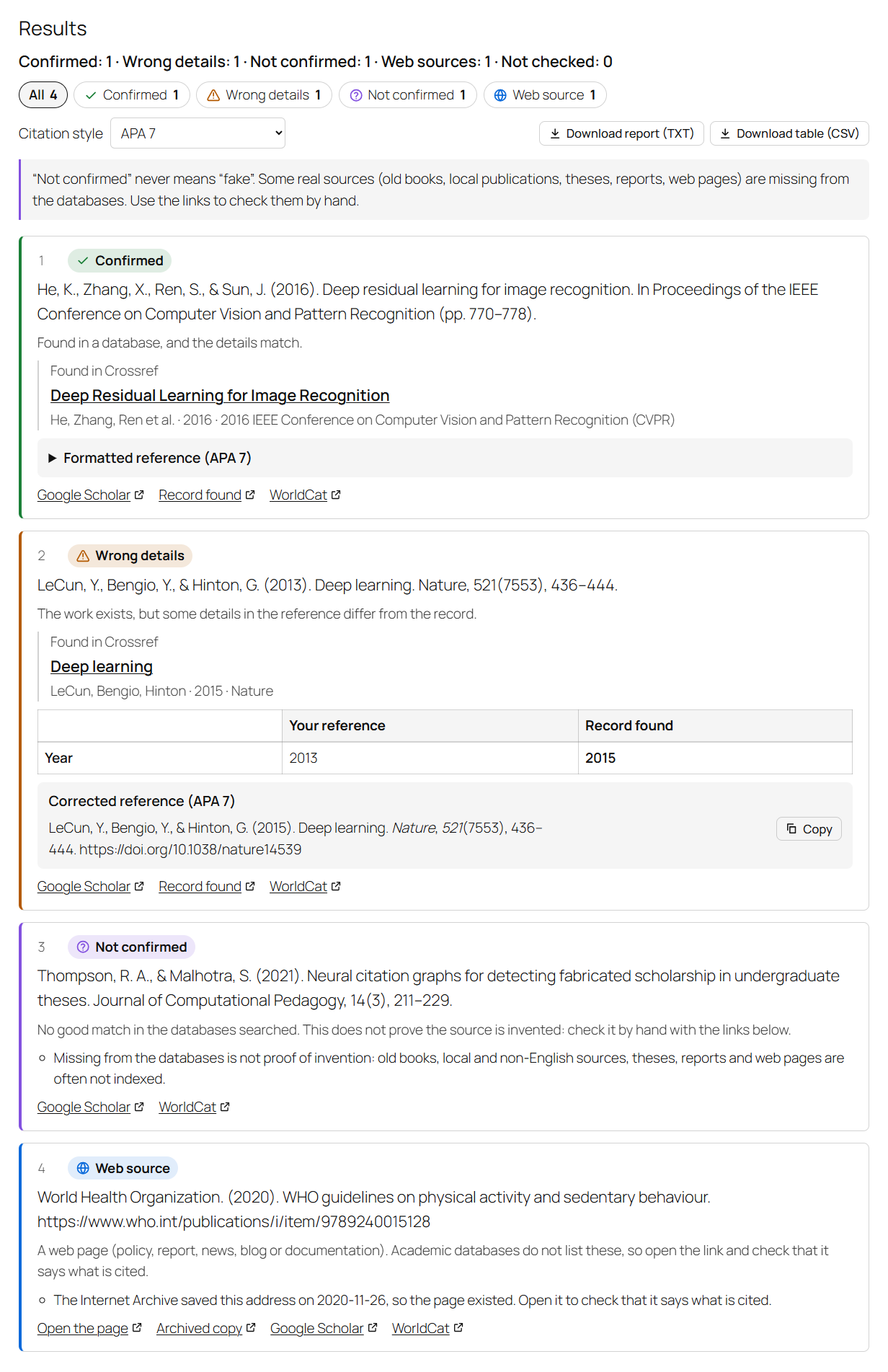
Confirmed

Found in a database, and the details match.

Wrong details

The work exists, but the year, authors, title, journal or DOI differ from the record. Both values are shown side by side and, when the authors match, a corrected reference to copy in APA 7, MLA 9, Chicago, Harvard, IEEE, Vancouver or ISO 690.

Not confirmed

No good match in the databases. Links to Google Scholar, WorldCat and, if you set one, your own library catalog help visitors check by hand.

Web source

A report, policy, news article or blog post, which academic databases do not list. The plugin asks the Internet Archive whether the page was saved.

"Not confirmed" never means "fake". Older books, local publications, theses and reports are often missing from the databases, and the form says so next to every such result.

Bibliography Checker results: references marked confirmed, wrong details, not confirmed and web source, each with the record found.
Screenshot Open the full results

Nothing reaches your server

The check runs in each visitor's own browser, which talks directly to the public databases. Your server only delivers the page.

  • References and results are never saved, logged or emailed.
  • No personal data in your database and no cookies.
  • Nothing goes to the plugin author. No account, no limit, nothing to pay.
  • Lookups are cached in the visitor's browser for up to 30 days, so a second check is instant.
  • Suggested text for your privacy policy is added to Settings → Privacy.

Light and accessible

  • One small script (about 30 KB compressed) and one stylesheet, loaded only on pages with the checker.
  • No jQuery, no React on the front end.
  • The form takes its fonts and colors from your theme.
  • Results are written in words, not only colors; it works with the keyboard and screen readers.
  • Translatable, and follows your site's language.

Make it yours

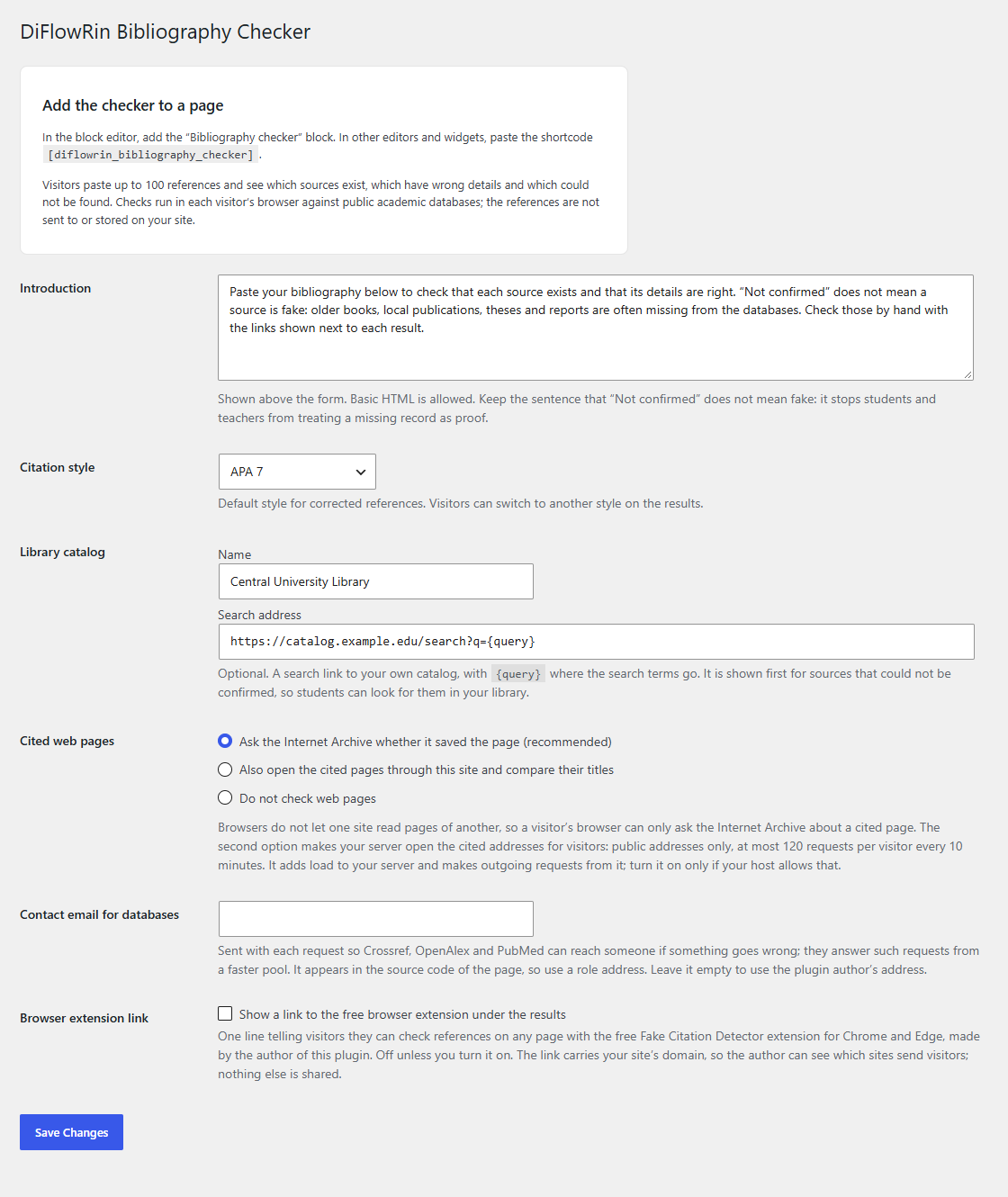
Under Settings → Bibliography Checker you can set:

  • The introduction text above the form.
  • The default citation style for corrected references.
  • Your library catalog's search address, shown first for sources that could not be confirmed.
  • How cited web pages are checked: through the Internet Archive (default), or opened by your server, with strict limits.
  • A contact email sent to the databases, as they request.
The Bibliography Checker settings page in WordPress, with the introduction text, citation style and library catalog link.

How accurate is it?

It uses the same checking engine as the Fake Citation Detector browser extension.

0

real references marked "not confirmed"

120of 120

invented references caught

55of 55

references with a changed year, journal or author flagged

Tested in October 2026 on about 400 references in seven citation styles. Real bibliographies are messier, especially for older and local sources, so treat the result as a first pass, not a verdict.

Install in a minute

  1. Install

    In WordPress, go to Plugins → Add New, search for DiFlowRin Bibliography Checker, then install and activate it.

  2. Add it to a page

    Add the Bibliography checker block, or paste [diflowrin_bibliography_checker] into a Shortcode block, a classic page or a text widget.

  3. Adjust if you like

    Review Settings → Bibliography Checker: introduction, citation style and library catalog link.

WordPress 6.3 or higherPHP 7.4 or higherVersion 1.0.0Open source (GPL)

Downloads from WordPress.org

150

Daily downloads read live from the WordPress.org plugin API, over the last 30 days it returns. The plugin has been in the directory since 28 October 2026.

69
Busiest day, 1 November 2026
25
Average day over the period
1.0.0
Current release, 28 October 2026
6
Days of figures returned
28 Oct 26 Nov

From the same author

Prefer to check references in your own browser?

Fake Citation Detector is the free Chrome and Edge extension with the same checking engine, plus right-click checks and checking the sources of any article you read. For checking whether a source actually supports a claim, there is DiFlowRin Research.

Questions

Does "Not confirmed" mean the reference is fake?

No. It means none of the databases searched had a good match. Many real sources are missing from them: old books, local and non-English publications, theses, reports, standards and web pages. The form says so next to every such result and offers links to check by hand.

How accurate is it?

It uses the same checking engine as the Fake Citation Detector browser extension. On about 400 test references in October 2026, no real reference was marked Not confirmed, all 120 invented references were caught, and all 55 references with a changed detail were flagged as having wrong details. Real bibliographies are messier, so treat the result as a first pass, not a verdict.

Is my visitors' data sent to my server or to you?

No. The visitor's browser talks directly to the public databases. Nothing goes to your server, unless you turn on the optional page proxy, which only receives the addresses of cited web pages, and nothing goes to the plugin author.

Will it slow down my site?

The script and stylesheet load only on pages that contain the checker, and the script is deferred. Pages without the checker load nothing from this plugin.

Can I change the colors?

The form uses your theme's fonts and text colors, and the button follows your theme's primary color when it defines one. You can also set it with custom CSS, for example .bibc { --bibc-accent: #0a5c36; }.

Can I use it in another language?

Yes. All texts can be translated through translate.wordpress.org or with a translation plugin such as Loco Translate. The interface follows your site's language.

Why only 100 references at a time?

The databases are free public services. Checking at most 100 references at a time, a few at once, with short pauses, keeps the tool within their fair-use rules.
Put a reference checker on your site today

Free · Open source · WordPress 6.3+ · PHP 7.4+