
A fabricated citation is not a typo. It is a reference whose claimed title corresponds to no publication that exists, often dressed in a real journal name, a plausible author list and a working identifier that resolves to a different paper. Between 2023 and 2026 this failure mode moved from a curiosity reported in small ChatGPT experiments to a measured feature of the biomedical and computer-science literature, a live enforcement problem at NeurIPS and ICLR, and a policy object for universities, publishers and journals. The evidence now supports three conclusions that are usually argued separately: the phenomenon is real and growing; its absolute prevalence is still small and unevenly concentrated; and the institutions responding to it have built detection and sanction regimes faster than they have built the adjudication capacity those regimes require.
1. Scale of the Problem and Its Evolution, 2023-2026
The strongest prevalence estimate comes from a biomedical audit published in The Lancet. Topaz and colleagues extracted 125.6 million references from 2.5 million PubMed Central open-access papers covering January 2023 to February 2026. They resolved 97.1 million references carrying a DOI or PubMed identifier against PubMed, Crossref, OpenAlex and Google Scholar. After filtering and manual validation they confirmed 4,046 fabricated citations in 2,810 papers [1]. The quarterly rate rose from roughly four fabricated citations per 10,000 papers in 2023 to 56.9 per 10,000 in early 2026, a more than twelvefold increase; at paper level the share carrying at least one fabricated reference went from about one in 2,828 in 2023 to one in 458 in 2025 and one in 277 in early 2026 [1] [2]. The same audit found a concentration that matters more than the average: the highest-rate publisher produced fabrications at 56.8 per 10,000 papers against 3.9 for the most selective journals in the dataset, a fourteenfold gap, and more than a third of all confirmed fabrications came from just two publishers [1].
A second large corpus points the same direction with a different method. Zhao and colleagues examined roughly 111 million references across arXiv, bioRxiv, SSRN and PubMed Central, matched titles against scholarly databases, and compared post-2023 unmatched rates with a pre-LLM baseline. They estimated about 146,932 potentially hallucinated citations in 2025, with rates of 0.39% for arXiv, 0.21% for bioRxiv, 1.91% for SSRN and 0.27% for PubMed Central [2]. The social-sciences preprint repository is the outlier in both direction and magnitude, a finding corroborated by Nature‘s coverage of the same work [3]. Neither audit attributes individual citations to a model; both treat the post-2023 inflection as consistent with LLM use while allowing paper mills and manual manipulation as alternative causes [2].
Computer science shows a sharper but smaller-scale rise. An archival audit of 2.2 million citations from 56,381 papers at eight AI/ML and security venues found that 1.07% of papers contained at least one definitively invalid citation, with 739 invalid citations across 604 papers; the annual rate climbed from a 0.89% average over 2020–2024 to 1.61% in 2025, an 80.9% increase [4]. A stricter identity-level study of top-tier proceedings found reference-level rates usually below 1% but paper-level prevalence far higher. Roughly one in four accepted NeurIPS 2025 papers contained at least one likely hallucinated reference, and roughly one in twenty contained at least two even after stripping ordinary bibliographic drift [5]. The same study documents a growing high-count tail — papers with five or more hallucinated references in one bibliography rose from zero in 2021 to 48 in 2025 — and found likely fabrications among award-winning papers, not only marginal ones [5].
The preprint layer is worse than the published layer. A research letter comparing medRxiv preprints with peer-reviewed articles found fabricated references at 37.2 versus 16.4 per 10,000, a relative risk of 2.27 (95% CI 1.94–2.67, p<0.001) across 42,249 preprints and 157 confirmed fabricated references in 104 preprints [6]. The trend is consistent across four independent measurement designs, four corpora and two continents of authorship: fabrication is no longer a tail risk of isolated chatbot misuse but a measurable and rising component of the citation record [1] [4] [5] [6].
2. Invented-Reference Rates by Model, Domain, and Prompt Type
The single most quoted benchmark is also the most easily misread. GhostCite tested 13 state-of-the-art models on citation generation across 40 computer-science domains and found that every model hallucinated at least some citations, with rates spanning 14.23% to 94.93% [4]. The per-model ordering is stark [4].
- DeepSeek — 14.23%
- GLM-4.5 — 21.25%
- Claude 4 — 21.84%
- Qwen-3 — 23.52%
- Kimi — 41.86%
- Llama 4 — 45.84%
- GPT-5 — 50.92%
- Gemini — 59.47%
- ERNIE — 71.90%
- Seed — 78.64%
- Grok 4 — 79.98%
- Phi-4 — 87.47%
- Hunyuan — 94.93%
These are not vendor-neutral conditions — the benchmark asks models to produce citations, which rewards recall of bibliographic strings and punishes abstention — but they establish that model identity is a first-order determinant of fabrication risk, not a rounding error.
Earlier studies show both the same dispersion and a clear generation effect. Walters and Wilder asked GPT-3.5 and GPT-4 to write literature reviews across 42 topics and found that 55% of GPT-3.5 citations but only 18% of GPT-4 citations were fabricated; among citations that did resolve, 43% and 24% respectively carried at least one substantive bibliographic error [7]. Book chapters were the worst case even for the better model, with 70% fabricated [7]. Pooling six prior investigations, the same paper put the fabricated share at 51% of 732 citations, with per-study rates typically between 47% and 69% [7].
A 2023 Cureus study of 115 references generated for 30 short biomedical papers found only 7% both authentic and accurate, 47% fabricated and 46% authentic but inaccurate, with a mean of 4.3 wrong elements out of seven per reference and an incorrect PMID in 93% of papers [8]. Chelli and colleagues, testing whether ChatGPT and Bard could reproduce human systematic reviews, observed hallucinated references at 28% to 91% and maximum precision and recall of 13.4% and 14.7% [9].
Newer models have not eliminated the problem; they have redistributed it between fabrication and abstention. In a rosacea question-answering study, ChatGPT-5.2 cited references for all 20 questions with hallucination rates between 18.2% and 50.0%, DeepSeek-V3.2 cited for all 20 at 10.0% to 58.3%. Claude Sonnet 4.5 declined to give specific references in 14 of 20 answers and hallucinated one of the six reference sets it did provide (12.5%) [10]. The trade-off has a cost: the same study scored Claude lowest on a modified DISCERN reliability measure (25.60 versus 31.45 for ChatGPT-5.2 and 31.95 for DeepSeek-V3.2), because an answer without citations is less useful to a clinician even when it is safer [10]. Fabrication rates are therefore not a pure capability ranking; they interact with a model’s willingness to say it does not know.
Domain effects are large and systematic. In the Cureus prompt experiment, fabricated-reference rates ranged from 10% in immunology to 75% in pulmonology, with dermatology at 64%, gastroenterology at 62% and mental health at 60% [8]. A JMIR Mental Health study of six GPT-4o literature reviews found 35 of 176 citations (19.9%) fully fabricated and 64 of the 141 real citations (45.4%) bibliographically erroneous, with fabrication at 28% for binge eating disorder and 29% for body dysmorphic disorder against 6% for major depressive disorder [11]. Less publicly visible conditions and narrower topics produced more fabrication, a pattern the authors attribute to sparser training signal [11]. The preprint-versus-journal gap and the SSRN outlier fit the same logic: the thinner the indexing and the newer the literature, the weaker the model’s grounding [6] [2].
Prompt design is the most controllable lever. Algaba and colleagues found that GPT-4 suggested existing references for only about 65% of anonymized in-text citations under vanilla prompting, but that an iterative loop telling the model which references did not exist and asking it to replace them raised the existence rate to about 86% [12]. Later models improved the baseline — GPT-4o produced 2,409 non-existent references out of 8,961, and Claude 3.5 produced 282 out of 2,893 — but non-existent references remained statistically indistinguishable from real ones in title length, publication year and author count, which is precisely why human readers cannot spot them [12]. Retrieval changes the failure mode rather than removing it: models without web access produced valid source URLs only 40% to 70% of the time, while retrieval-augmented GPT-4 eliminated URL hallucination but still left around 30% of individual statements unsupported and nearly half of its responses not fully supported [13]. In the Cureus experiment, changing only the prompt’s framing moved fabrication from 34% to 66% within one prompt family [8].
One failure mode defeats the checks most readers perform. In a benchmark of five model snapshots answering clinical-informatics prompts, 69 of 130 citation-bearing responses contained a DOI that resolved to a different PMID than the one supplied. Among 116 citation units whose reported DOI resolved in PubMed, 99 pointed to a different paper than the stated PMID and only 17 to the stated one [14]. Every identifier in such a bundle can be individually valid while the bundle as a whole is incoherent, so checking one field confirms nothing [14]. The Lancet audit calls this plausible-title-plus-real-identifier pattern the dominant signature in its dataset [1].
3. Documented Cases at Conferences and Journals
NeurIPS 2025 is the best-documented conference case because two independent groups examined the same proceedings. A vendor scan of 4,841 of the 5,290 accepted papers found more than 100 human-confirmed hallucinated citations across 51 accepted papers — the accompanying table lists 53 — every one of them missed by the three or more reviewers who had evaluated the paper [15]. The affected papers had already been accepted, presented and effectively published when the findings were reported [15]. A subsequent failure-mode taxonomy of those 100 citations classified 66% as total fabrication, 27% as partial attribute corruption, 4% as identifier hijacking, 2% as placeholder hallucination and 1% as semantic hallucination, and found that every citation exhibited compound failure modes: 63% also carried a semantically plausible but non-existent title, and 29% also hijacked a valid identifier [16].
The compound structure is the explanation for why review failed — a fabricated title defeats memory, a real author list defeats recognition, and a working link defeats the click test [16]. Ninety-two percent of contaminated papers contained only one or two fabrications, while a small tail contained four to thirteen, a bimodal pattern the author reads as occasional copy-editing help versus systematic reliance on generated references [16].
The independent audit reached a higher paper-level estimate using a stricter definition that excludes ordinary bibliographic drift: about one in four accepted NeurIPS 2025 papers contained at least one likely hallucinated reference, and about one in twenty contained at least two [5]. It also found that a single venue’s 3,703 accepted papers and 221,281 references could be scanned for about $157, or roughly four cents per paper, which reframes verification as an operational choice rather than a budgetary impossibility [5].
ICLR 2026 produced the clearest enforcement record. A vendor scan of 300 submissions under review found 50 containing at least one obvious hallucinated citation, none previously reported, even though each had already been read by three to five reviewers and some carried average ratings of 8/10 . The program chairs subsequently confirmed that every submission with a confirmed hallucinated reference was desk rejected, with an appeal channel for erroneously flagged papers [18]. Of 19,525 valid submissions, 779 were desk rejected for procedural or content violations and 5,042 were withdrawn, leaving 13,763 decisions based on 76,139 reviews from 18,054 reviewers; 5,355 papers were accepted and 8,408 rejected, a 27.4% acceptance rate [18].
The chairs attributed part of the elevated desk-rejection rate to enforcing against hallucinated references and described the problem as widespread but relatively straightforward to detect. They added a caveat: their automated detector had a significant false-positive rate, and every flagged paper was reviewed by at least three humans [18].
Journals show the same pattern at smaller scale and with slower consequences. An April 2025 article in the Journal of Academic Ethics on whistleblowing by individuals with disabilities in Ethiopian public education was found by an independent researcher to contain at least 19 fabricated references among its 29, with 18 Google Scholar links returning nothing and many fabricated titles attributed to authors who had written on the topic but not that paper. Eleven of the fabricated references pointed to a different journal from the same publisher [19]. The corresponding author told Retraction Watch that he and his coauthors had used ChatGPT to generate the references while maintaining that the research and data were real — an admission that separates fabricated references from fabricated findings and complicates the usual misconduct framing [19]. The publisher said it was investigating and its research-integrity director noted that simple detection tools can produce false positives [19].
The upper tail is a 2025 oncology paper in which 18 of 30 verified references were fabricated, each tailored to the paper’s narrow surgical topic, attributed to real urologists, dated 2023 or 2024, and carrying a real PMID or DOI that resolved to an unrelated paper [1]. At the level of consequences, a bibliometric review of 335 retracted AI-related publications found a median 550 days from publication to retraction, 46.3% of retractions occurring in 2023, compromised peer review as the most common stated reason, no specific justification in 37.9% of notices, and 51.1% of retracted articles still attracting citations at a normal rate [20]. Retraction is therefore neither fast nor self-correcting: the citation record keeps propagating the retracted work while the notice is processed [20].
4. Efficacy and Failure Modes of Fabricated-Citation Detection
Detection has improved quickly and remains unreliable in ways that matter for sanctions. The best published results come from retrieval-grounded systems. CITECHECK, which resolves each reference against scholarly indexes and escalates ambiguous cases, reached 88.7 macro-F1 and 88.9% accuracy on a held-out 982-citation physics benchmark. It beat the strongest direct-LLM baseline — Claude Sonnet 4.6 with web search and few-shot examples — by 5.8 macro-F1 points while remaining zero-shot [21]. The same study shows why retrieval is essential: enabling web search lifted GPT-5.4 from 62.7 to 73.1 macro-F1, Claude Sonnet 4.6 from 68.7 to 81.2 and Gemini 2.5 Flash from 55.1 to 78.3, evidence that parametric knowledge alone cannot separate a plausible fabrication from a real paper [21]. It also found that minor hallucinations — a real paper with corrupted metadata — are consistently harder to detect than major ones, with CITECHECK scoring 81.7 F1 on the minor class against 76.6 for the best baseline [21].
An agentic zero-assumption protocol reported a 91.7% verification rate across 1,212 references from 24 PLOS papers with a false-positive rate below 0.5%, fewer than five wrongly flagged references, and audited a 916-reference doctoral thesis in 90 minutes [22]. Its limits matter: verification is abstract-level and cannot detect content misrepresentation, non-English references (about 8% of its second-phase corpus) cannot be verified, and human oversight remains necessary [22]. The same study found fabricated or false references in 12.5% of its PLOS sample and year errors in 25%, a reminder that validation corpora are not pristine [22].
The clearest evidence on failure modes comes from a head-to-head test of five open tools on a manually verified set of 104 references containing 33 problematic ones [2].
| Tool | Detected (of 33) | Missed (of 33) | False positives (of 71) |
|---|---|---|---|
| CheckIfExist | 31 | 2 | 34 |
| RefChecker | 32 | 1 | 36 |
| HalluCiteChecker | 18 | 15 | 20 |
| Hallucinator | 29 | 4 | 28 |
| HalRef | 24 | 9 | 53 |
The study’s conclusion is blunt: these tools are useful for preliminary screening but their output should not be treated as a final decision. Reference extraction from PDFs, BibTeX formatting sensitivity, incomplete database coverage and API restrictions all degrade performance, and general AI-text detectors such as Pangram do not verify reference existence at all [2].
Using a frontier model as the verifier does not solve the problem either. On a 1,248-decision citation-quality benchmark, GPT-5-mini achieved the strongest source-relevance F1 at 0.908 while Claude Opus 4.6 led the harder factual-support dimension at 0.750. No model dominated both. Judge cost spanned a 49-fold range without predicting accuracy, and false-negative rates on factual support ranged from 0.183 to 0.470, meaning some judges over-reject nearly half of genuinely supported citations [23]. At comparable F1, judges differed substantially in pass-rate drift and in false-positive versus false-negative balance, a directional bias invisible to a scalar score [23]. The benchmark also found that factual-support accuracy in deep-research citation evaluation drops by about 42% as retrieval depth scales from 2 to 150 tool calls, so verification quality degrades exactly where agents do the most searching [23].
Vendor tools occupy a different point on the trade-off. GPTZero claims to catch 99 of 100 flawed citations while conceding a higher false-positive rate because it flags any citation it cannot verify online. That design choice is defensible for triage and dangerous for adjudication, and it is precisely why ICLR layered human review over its detector rather than acting on detector output [18] [24]. The practical gap is not detection of total fabrication, which is tractable, but detection of identifier hijacking and metadata corruption, where a valid link points at the wrong paper [14] [16].
Human review is not a reliable backstop. In a survey of 97 researchers, 87.2% used AI-powered tools in their workflows and 41.5% admitted copy-pasting BibTeX entries without checking. Among respondents, 76.7% said reviewers do not thoroughly inspect references, 74.5% viewed peer review as ineffective at catching citation errors, and 70.2% strongly supported automated checks [4]. The NeurIPS and ICLR cases confirm the self-report: fabricated references survived three to five expert reviewers, and in one NeurIPS case a placeholder citation reading “Firstname Lastname” reached the published proceedings [16].
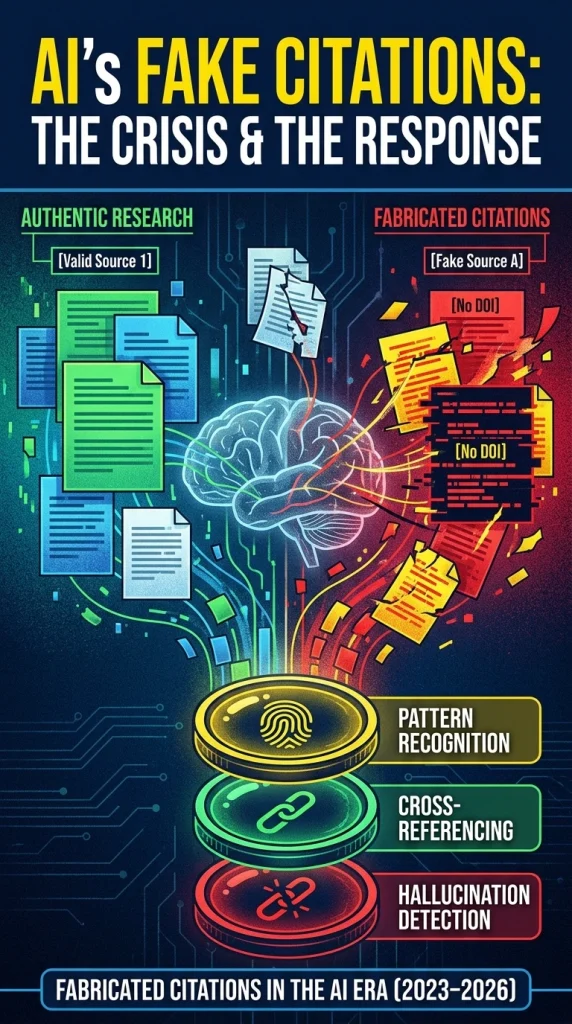
5. Institutional Responses and Where Experts Disagree
Conference policy has moved from disclosure to sanction. NeurIPS 2025 classifies content that is not scientifically sound — explicitly including references generated by an LLM without due diligence to verify correctness, existence and appropriateness — as a Code of Conduct violation. It reserves the right to investigate after publication and to revoke a paper’s publication status, and bars reviewers from sharing submissions with any LLM [25]. The NeurIPS 2026 main-track handbook states that hallucinated citations in literature reviews violate the Code of Conduct and enumerates an escalation ladder [26]:
- removal from the reviewing system
- rejection of all papers under consideration
- revocation of publication status
- notification of home institutions
- information sharing with sister conferences
- sanctions at future NeurIPS
It also restricts reviewing to a single conference-sanctioned model on designated papers, an experiment designed to measure how LLM support changes review quality [26].
ICLR 2026 built the most explicit regime. Its policy requires disclosure of any LLM use in a submission or review and makes authors and reviewers personally responsible for LLM output. It treats a substantial falsehood or misrepresentation produced by an LLM as a Code of Ethics violation by the human, with desk rejection as a concrete consequence, and counts hidden prompt injections planted to elicit a positive LLM review as collusion, for which both author and reviewer are accountable [27] [28].
A follow-up post confirmed that papers with extensive undisclosed LLM use producing false claims or hallucinated references are desk rejected, that reviewers who posted hallucinated references in their own reviews face desk rejection of their submitted papers, and that detection tools are used only for triage because of false-positive risk [24]. The retrospective adds the operational detail that mattered: 779 desk rejections, an appeal channel, and at least three human reviewers on every flagged paper [18]. A separate survey of the same proceedings notes that ICML 2026 also lists hallucinated references as grounds for desk rejection [5].
Publishers have converged on author responsibility and disclosure rather than verification. Elsevier states that AI-generated references can be incorrect, hallucinated or fabricated, and that inclusion of fabricated references may lead to rejection. It further states that fabricating or altering references is an example of inappropriate AI use, and that authors must declare any AI tool used to select, collate, generate or edit references [29]. The ICMJE requires disclosure of AI-assisted technologies at submission, prohibits citing AI-generated material as a primary source, bars chatbots from authorship because they cannot be accountable, warns that nondisclosure may be construed as misconduct, and requires reviewers to keep manuscripts confidential from AI tools and to disclose and verify any AI use in review [30] [31]. The coverage of these rules is uneven: one review reports that 87% of top journals have explicit generative-AI guidelines but only 24% of top publishers do [20].
Universities have moved more slowly and less uniformly. Cornell’s Code of Academic Integrity, effective 24 August 2026, names citing fabricated or non-existent sources — including false citations generated by artificial intelligence — as an explicit violation. It makes students responsible for the accuracy and existence of every source regardless of how it was produced or obtained. It also classifies AI-provided aid as unauthorized assistance alongside help from people or devices [32].
Cambridge’s Department of History and Philosophy of Science treats submission of falsified information, explicitly including fake references, as misconduct whether or not AI produced it. It prohibits using AI as a source or quoting its output, requires a signed cover sheet declaring AI use, refuses to distinguish AI assistance from human assistance in drawing the plagiarism line, and blanket-screens work with Turnitin [33].
These are strong rules, but they are departmental or institutional exceptions. A study of the top 50 US universities found that 94% had faculty-facing GenAI guidelines while only 26% included policy information on academic integrity in those guidelines, and 54% simply advised faculty to set their own course-level policies [34]. A second study of 50 innovative US universities found instructor-led syllabus-level governance, disclosure and attribution expectations, privacy guardrails and caution toward AI-detection systems, but no convergent standard for verifying cited sources [35].
The expert disagreement is real, but narrower than it appears from the headlines. The NeurIPS board’s statement, quoted in a statistical commentary, concedes that incorrect references exist while insisting that “the content of the papers themselves are not necessarily invalidated.” It suggests that authors may simply have asked a model to format a bibliography from a partial description [36]. Critics reply that this understates the epistemic function of a citation: if a reader cannot identify the cited work, the evidentiary link is broken regardless of whether the surrounding argument is sound, and a policy that treats fabrication as a formatting slip invites more of it [36]. The disagreement is sharpest on three questions: whether one bad reference invalidates a paper; whether prevalence estimates are inflated by definitional choices; and whether automated flags are accurate enough to support sanctions [36] [5].
The evidence supports a split verdict on whether one bad reference invalidates a paper. A single hallucinated reference in an otherwise well-supported paper is a serious citation-integrity failure but not proof that the findings are wrong. The ethics-journal case, where the authors admitted generating references with ChatGPT while asserting that the research and data were real, is exactly this scenario [19]. But the high-count tail — 18 of 30 references in one paper, 13 in a single NeurIPS bibliography — is not a formatting slip, and the compound failure modes documented at NeurIPS suggest deliberate-looking pattern completion rather than isolated error [1] [16]. A policy that cannot distinguish the two will either over-punish or under-detect.
Definitional choices explain a large part of the spread. Reference-level rates below 1% and paper-level rates near 25% are not contradictory; they measure different things [5]. Rates also depend on whether ordinary bibliographic drift counts, whether the denominator is all references or only those with resolvable identifiers, and whether unmatched titles are treated as fabrications or as indexing failures [2] [37]. The human baseline is not zero. Citation inaccuracy in the peer-reviewed literature has been estimated at 4% to 48%, roughly 20% of citations are said to contain errors, up to 50% of citations are perfunctory, and 80% of authors are said to cite without reading the full text [8] [22] [37]. LLM-generated references also resemble human citation patterns closely, including a heightened high-citation bias, which means some of what looks like a new pathology is an amplification of old ones [12] [37].
The detection literature is unambiguous that current tools are not adjudication-grade. False-positive counts exceed true positives for several tools on a balanced test set, and frontier judges trade false positives against false negatives in ways a single F1 hides. Identifier hijacking defeats the one check most reviewers perform [2] [23] [14]. The defensible position is therefore not that fabrication is exaggerated or that it is catastrophic, but that the response must be proportional to a measured, concentrated and rising risk.
That means mandatory automated reference verification at submission, with human adjudication reserved for flagged cases; explicit rules that treat identifier mismatch as seriously as non-existence; publisher-level verification rather than author declaration alone; and university policies that name fabricated references directly instead of relying on generic AI-use rules [5] [4] [1]. The technology to scan a venue for four cents a paper already exists; what is missing is the institutional decision to run it before publication rather than after the citations have entered the record [5].
Sources
- Maxim Topaz et al. (2026). Fabricated citations: an audit across 2·5 million biomedical papers. The Lancet. https://doi.org/10.1016/S0140-6736(26)00603-3 [1]
- Detecting Hallucinated and Suspicious Citations: What Current. arXiv:2607.22693 [2]
- Chris Stokel-Walker (2026). Hallucinated citations highest in social sciences preprints site. Nature. https://doi.org/10.1038/d41586-026-01545-1 [3]
- Zuyao Xu et al. (2026). GhostCite: A Large-Scale Analysis of Citation Validity in the Age of Large Language Models. arXiv.org. arXiv:2602.06718 [4]
- Phantom References: Hallucinated Citations That Survive Peer Review. arXiv:2607.00738 [5]
- Maxim Topaz et al. (2026). Fabricated references are twice as common in medRxiv preprints as in peer‐reviewed articles. Journal of Internal Medicine. https://doi.org/10.1111/joim.70139 [6]
- William H. Walters and Esther Isabelle Wilder (2023). Fabrication and errors in the bibliographic citations generated by ChatGPT. Scientific Reports. https://doi.org/10.1038/s41598-023-41032-5 [7]
- Mehul Bhattacharyya et al. (2023). High Rates of Fabricated and Inaccurate References in ChatGPT-Generated Medical Content. Cureus. https://doi.org/10.7759/cureus.39238 (read at https://assets.cureus.com/uploads/original_article/pdf/158289/20230618-23404-wiiz34.pdf) [8]
- Mikaël Chelli et al. (2024). Hallucination Rates and Reference Accuracy of ChatGPT and Bard for Systematic Reviews: Comparative Analysis. Journal of Medical Internet Research. https://doi.org/10.2196/53164 (read at https://s3.ca-central-1.amazonaws.com/assets.jmir.org/assets/preprints/preprint-53164-accepted.pdf) [9]
- Mahmut Talha Uçar et al. (2026). Comparative Evaluation of ChatGPT-5.2, Claude Sonnet 4.5, and DeepSeek-V3.2 for Rosacea-Related Information: Accuracy, Reliability, Readability, and Reference Hallucinations. Diagnostics. https://doi.org/10.3390/diagnostics16162620 (read at https://www.ebi.ac.uk/europepmc/webservices/rest/PMC13512755/fullTextXML) [10]
- Jake Linardon et al. (2025). Influence of Topic Familiarity and Prompt Specificity on Citation Fabrication in Mental Health Research Using Large Language Models: Experimental Study. JMIR Mental Health. https://doi.org/10.2196/80371 [11]
- A. Algaba et al. (2024). Large Language Models Reflect Human Citation Patterns with a Heightened Citation Bias. arXiv.org. arXiv:2405.15739 [12]
- How well do LLMs cite relevant medical references? An evaluation framework. arXiv:2402.02008 [13]
- Göktuğ Özkan (2026). Do Large Language Models Link to Incorrect Citations? A PubMed and DOI Benchmark. Applied Clinical Informatics. https://doi.org/10.1055/a-2972-4974 [14]
- S. Ansari (2026). Compound Deception in Elite Peer Review: A Failure Mode Taxonomy of 100 Fabricated Citations at NeurIPS 2025. arXiv.org. arXiv:2602.05930 [16]
- ICLR 2026 Program Chairs (2026). A Retrospective on the ICLR 2026 Review Process. ICLR Blog. https://blog.iclr.cc/2026/03/31/a-retrospective-on-the-iclr-2026-review-process/ [18]
- The case of the fake references in an ethics journal – Retraction Watch. https://retractionwatch.com/2025/12/02/fake-references-chatgpt-journal-academic-ethics-springer-nature-whistleblowing/ [19]
- Kannan Sridharan and Gowri Sivaramakrishnan (2026). Artificial intelligence in the retraction spotlight: trends, causes and consequences of withdrawn AI literature through a systematic bibliometric review. Frontiers in Research Metrics and Analytics. https://doi.org/10.3389/frma.2025.1737168 (read at https://public-pages-files-2025.frontiersin.org/journals/research-metrics-and-analytics/articles/10.3389/frma.2025.1737168/pdf) [20]
- CITECHECK: Retrieval-Grounded Detection of LLM Citation. arXiv:2605.27700 [21]
- L. V. van Rensburg (2025). AI-Powered Citation Auditing: A Zero-Assumption Protocol for Systematic Reference Verification in Academic Research. arXiv.org. arXiv:2511.04683 [22]
- Do You Need a Frontier Model as a Citation Verifier?. arXiv:2607.08700 [23]
- ICLR 2026 Program Chairs (2025). ICLR 2026 Response to LLM-Generated Papers and Reviews. ICLR Blog. https://blog.iclr.cc/2025/11/19/iclr-2026-response-to-llm-generated-papers-and-reviews/ [24]
- NeurIPS 2025 Program Chairs (2025). NeurIPS 2025 Policy on the Use of Large Language Models. NeurIPS 2025. https://neurips.cc/Conferences/2025/LLM [25]
- NeurIPS 2026 Program Chairs (2026). NeurIPS 2026 Main Track Handbook. NeurIPS 2026. https://neurips.cc/Conferences/2026/MainTrackHandbook [26]
- ICLR 2026 Program Chairs (2026). Policies on Large Language Model Usage at ICLR 2026 (FAQ). ICLR 2026. https://iclr.cc/FAQ/LLM [27]
- ICLR 2026 Program Chairs (2025). Policies on Large Language Model Usage at ICLR 2026. ICLR Blog. https://blog.iclr.cc/2025/08/26/policies-on-large-language-model-usage-at-iclr-2026/ [28]
- Elsevier (2026). Generative AI policies for journals. Elsevier. https://www.elsevier.com/about/policies-and-standards/generative-ai-policies-for-journals [29]
- ICMJE (2026). ICMJE Recommendations: Use of AI by Authors. ICMJE. https://www.icmje.org/recommendations/browse/artificial-intelligence/ai-use-by-authors.html [30]
- ICMJE (2026). ICMJE Recommendations: Use of AI by Reviewers. ICMJE. https://www.icmje.org/recommendations/browse/artificial-intelligence/ai-use-by-reviewers.html [31]
- Cornell University Office of the Dean of Faculty (2026). Cornell University Code of Academic Integrity. Cornell University. https://deanoffaculty.cornell.edu/faculty-and-academic-affairs/academic-integrity/upcoming-code-of-academic-integrity/ [32]
- University of Cambridge Department of History and Philosophy of Science (2026). Academic misconduct: plagiarism and use of AI. University of Cambridge. https://www.hps.cam.ac.uk/students/academic-misconduct [33]
- Yunjo An et al. (2025). Investigating the higher education institutions’ guidelines and policies regarding the use of generative AI in teaching, learning, research, and administration. International Journal of Educational Technology in Higher Education. https://doi.org/10.1186/s41239-025-00507-3 [34]
- Yufeng Qian (2026). Governing generative AI in higher education: emerging policy approaches and support ecosystems at innovative U.S. Universities. International Journal for Educational Integrity. https://doi.org/10.1007/s40979-026-00233-x [35]
- Machine learning research is not serious research and therefore hallucinated references are not necessarily a big deal, agrees a prestigious group of machine learning researchers | Statistical Modeling, Causal Inference, and Social Science. https://statmodeling.stat.columbia.edu/2026/01/26/machine-learning-research-is-not-serious-research-and-therefore-hallucinated-references-are-not-necessarily-a-big-deal-agrees-a-prestigious-group-of-machine-learning-researchers/ [36]
- Lutz Bornmann and Christian Leibel (2026). Citation accuracy, citation noise, and citation bias: a foundation of citation analysis. Scientometrics. https://doi.org/10.1007/s11192-026-05841-5 (read at https://arxiv.org/pdf/2508.12735) [37]
- This article includes content created with AI.