
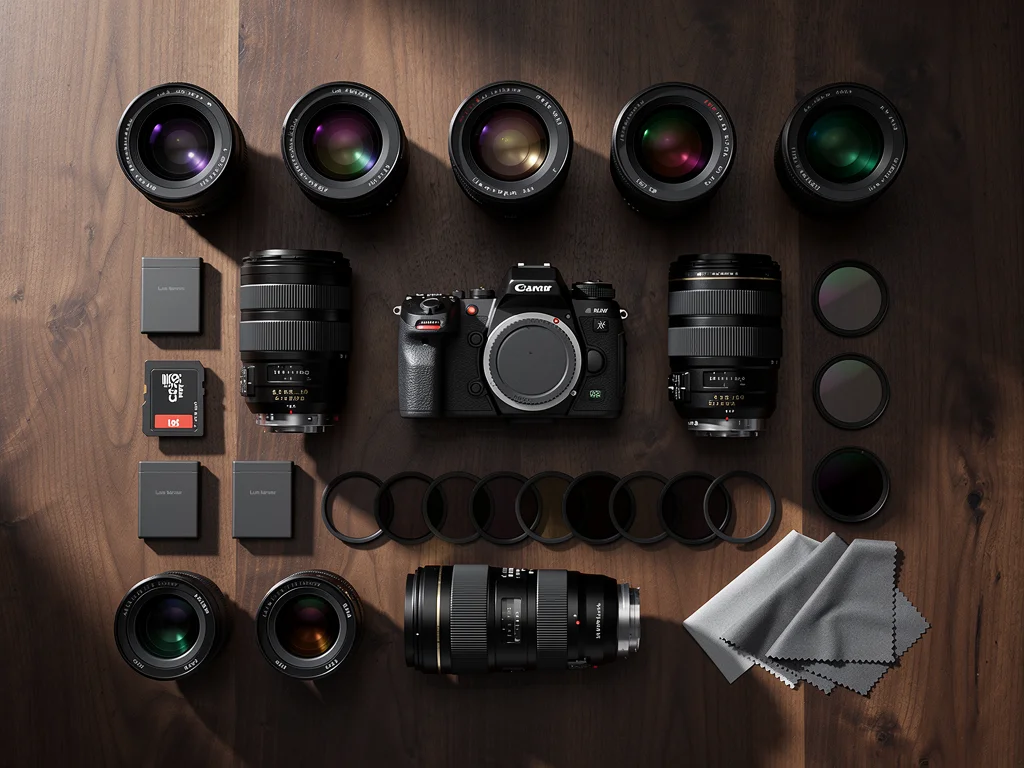
Most photographers own a kit worth thousands, and most of them track it the same way: a spreadsheet nobody updates, receipts scattered across email, and a memory of who borrowed what. That is the real state of camera gear inventory management for a lot of working shooters.
Picture it. One spreadsheet row reads “Sigma 35, maybe Jake has it?”. The lens receipt is buried in a forwarded order confirmation. The camera bag holds two flat batteries and an old lens cap. And someone in the group chat is asking who took the second V-mount home.
GearDex is a camera gear inventory app built for exactly this mess. It runs in the browser on phones, tablets and computers, and as a desktop app for Mac and Windows. Every body, lens, filter and drone gets one record with its details attached. Below is how it works, which features are free, and which ones need a paid plan.
Why the spreadsheet loses
A spreadsheet stores rows, and it does that well. But it has no idea what a lens mount, a warranty or a loan is. Each of those becomes a column you maintain by hand.
The questions a working photographer asks are not row questions. Who has the flash? Is this body still under warranty? What is the kit worth for insurance? Which lenses fit the new body? When is the borrowed camera due back?
GearDex’s own comparison argues that Google Sheets and Apple Notes are free and flexible, but cannot track value over time, link documents to items, plan shoots, or print QR labels. That is the vendor’s framing, but the gaps it names are real. Older dedicated apps are not much help either: GearDex’s comparison table lists MyGearVault’s last iOS update as March 2022.
What one record holds
Each item gets one searchable record. It can hold category, brand and model, serial number, mount, photos, purchase details, value, condition, storage location, notes, receipts, warranty files, maintenance history and loan status.
Keep in mind that not every field is useful on the free plan. Receipts and warranty documents are effectively a Pro feature, since Starter allows only one gear document in total (more on this below).
How GearDex works, from import to insurance
The first objection is usually “I already have 300 rows in a spreadsheet.” Export them as CSV and import them. GearDex has templates for cameras, lenses, accessories, filters and drones, and it validates each row before saving.
The second objection is “I don’t want to retype serial numbers.” Smart Add turns a sentence, a pasted receipt or a photo into draft records. It fills in the model name, mount and filter thread, and flags items you already own. Nothing saves until you approve it. Note that Smart Add counts against your AI allowance: one action per item.
Getting started on the free plan
Sign up for Starter. It is free, needs no credit card, and holds up to 25 items in 10 categories.
Import your CSV, or use Smart Add for a handful of items. With 25 AI actions a week, a large Smart Add import will take more than one week.
Fill the gaps in each record: serial numbers, photos, condition and storage location.
Print QR labels for the items you carry, so anyone with a phone can identify them on set.
If you need receipts, warranty alerts and value tracking, upgrade to Pro. Starter allows only one gear document, and documents, warranty tracking and value reports are Pro features.
Tip: every plan, including the free one, can export your data: a full account ZIP with files, JSON records, or CSV for all gear or one type. Check this before you spend an afternoon populating any inventory tool.
Value tracking and warranty alerts (Pro and up)
On Pro, GearDex estimates the current value of each item and shows trends across the collection: 12 months of history on Pro and 24 months on Studio. The dashboard breaks value down by category and brand.
Warranty alerts fire before coverage ends, and Pro includes a one-click insurance PDF. The working sequence is: receipt attached, warranty card attached, alert before expiry, export to the insurer. None of that works on Starter, because it allows only one document.
Mount checks and price checks
Before you buy a lens, GearDex can check whether it fits the bodies you own, including through adapters already in your kit.
Market price lookups, which compare retailers such as B&H and Adorama, are a paid feature. They cover cameras and lenses only and are capped at 10 lookups a week on both Pro and Studio.
Iris: the AI assistant that reads your kit
A general chatbot does not know what is in your bag. Ask it which lens to bring and it may suggest one you don’t own. Ask whether a filter fits and it has to guess the thread size.
Iris, GearDex’s built-in assistant, checks your own records before it answers: gear, serial numbers, shoots, loans, maintenance and value. Ask which of your lenses fit a Canon R5, and it can tell you that your EF lenses work through the EF-RF adapter you already own. It distinguishes native fits, adapter fits and combinations that cannot work. Supported mounts include Canon EF, RF and RF-S, Nikon F and Z, Sony E and A, Fujifilm X and G, Micro Four Thirds, Leica L and M, and ARRI PL.
Iris can also prepare changes, but never applies them on its own. Anything that would change your account arrives as a card you confirm. It will not delete records, change your plan or publish anything.
Two of its most useful abilities are paid-plan only:
Lending cards (Pro and Studio): say “Lend the wedding kit to Jordan until Friday” and Iris prepares the check-out card. Pro’s limit of 3 open loans still applies.
Prep Review (Pro and Studio): in a shoot plan, it flags unavailable gear, a missing charger or a stale weather forecast, then waits for you to apply the changes.
Note: Iris itself is included on the free plan. Allowances reset every Monday: 25 actions a week on Starter (also capped at 100 a month), 150 a week on Pro (600 a month), and unlimited on Studio. Studio’s unlimited allowance belongs to the owner; team members don’t use Iris. Each chat message uses one action, and Smart Add uses one per item.
Shoot planning software for photographers
Inventory is half the job. The other half is the shoot itself.
Shoot plans in GearDex link to the gear you own. They hold locations, call sheets, weather, and sun, moon and tide times. A plan knows when an item on the packing list is out on loan or in maintenance.
Starter allows 3 shoot plans at a time, completed ones included, so you delete one to start another. Pro makes them unlimited and adds shot lists, packing and readiness workspaces, a unified timeline and crew call sheets with confirmations.
The point of a photography shoot planner with gear packing lists is simple. A wedding photographer packing the same two-body kit every Saturday should know it is complete before leaving, not when opening the bag at the venue.
Loans, QR labels and getting it all back
QR labels are on every plan. Scan an item with a phone to see what it is and where it stands.
Loans start at Pro. You reserve gear around shoots, scan it out, get due-date reminders, and scan it back in with any damage flagged. Pro allows 3 open loans at a time, each holding one item or one kit, plus signed agreements, wrap checks and carnet travel lists.
Studio removes the loan limit and allows multi-item check-outs. It also adds an availability board, recurring maintenance and a gear rental page that renters can book from.
Sites, galleries and the business side
GearDex also builds a photography website, with a live editor, client galleries and inquiries that feed back into the app.
Starter publishes a real site at geardex.app/yourname, with 3 themes, 3 pages and a small GearDex badge. Pro unlocks all 8 themes, 12 pages, a print shop, and your own domain without the badge. The custom domain is included in the $39-a-year Pro price, not charged separately.
Client galleries exist on every plan:
Plan | Galleries | Storage |
|---|---|---|
Starter | 1 | 250 MB |
Pro | 1 | 1 GB |
Studio | 10 active | 10 GB each, 100 GB total |
Studio adds a pipeline inbox, online booking, quotes, contracts and invoices. Clients pay through your own payment link: Stripe, PayPal, Venmo, Square, Cash App or any https link. GearDex never handles that money and takes no cut.
What it costs, and what the alternatives look like
Plan | Price | Key limits and features |
|---|---|---|
Starter | Free | 25 items, 10 categories, 3 shoot plans, QR labels, 1 gear document, 1 gallery, 25 AI actions a week |
Pro | $39/year or $4/month | Unlimited gear, 50 categories, documents and warranty alerts, value reports and insurance PDF, 5 rigs, full shoot planning, 3 open loans, 10 price lookups a week, 150 AI actions a week |
Studio | $179/year or $19/month | Pro plus booking, contracts, invoices, a team workspace with 10 seats, unlimited loans, availability board, ROI reports, API with webhooks, unlimited AI actions |
There is no free trial of the paid plans. Starter is the trial.
Cheaper tools exist. A comparison of photo inventory apps, published by Manifest (itself one of the apps compared), lists Home Contents as free for 25 items then a one-time $5.99, and Under My Roof as free for 10 items then $34.99 a year. Manifest costs $1.99 a month for about 15 scans, or $39 a year unlimited, after a 7-day trial. These apps catalog a house; they are not built around lens mounts or shoots.
On the camera-specific side, Camera Shelf takes a different approach: a one-time $9.99 Premium unlock, no subscription, no account, and data kept on your Apple devices with iCloud sync. It already covers packing kits, receipts, PDF reports and a basic lending tracker. What you give up compared with GearDex is the web and Windows access, the QR scan-out workflow with signed agreements, team features and the AI assistant.
The honest framing: if you want a list of what you own, cheaper tools do the job. If you want that list connected to shoots, loans, warranties, values and a website, that is the gap GearDex is aiming at, and most of that connection starts at Pro.
Warning: GearDex can keep serials, receipts, photos and values together and produce records for an insurance conversation. It does not provide insurance and doesn’t guarantee a claim will be paid.
Where it runs, and where it doesn’t
GearDex is a responsive web app that works in current browsers on phones, tablets and computers. Every plan, including Starter, works on every platform.
Platform | How you get it | Requirements |
|---|---|---|
Mac | GearDex Desktop download | macOS 13 Ventura or later, Apple Silicon or Intel |
Windows | GearDex Desktop download | Windows 10 or later, x64 or ARM64 |
iPhone and iPad | Add to Home Screen from Safari | Current iOS or iPadOS |
Android | Install app from Chrome | Current Android |
Web | Sign in at geardex.app | Current Chrome, Safari, Edge or Firefox |
What is missing is a native app in the iOS App Store or Google Play. The phone version is an installable web app, and it needs an internet connection, since everything syncs through the cloud. If a native, offline iPhone app is non-negotiable, weigh that.
On security, GearDex’s homepage says data is encrypted in transit and at rest and backed up continuously. Its pricing page is more cautious, naming HTTPS and Stripe billing and inviting questions about specifics. If security matters to your studio, ask before you commit. The export option matters most anyway: tools disappear, and your inventory shouldn’t disappear with them.
People Also Ask
Can GearDex replace a camera gear inventory spreadsheet?
Yes, for the inventory itself. Export your sheet as CSV, use the matching GearDex template, and the importer checks every row before saving. The extras a spreadsheet can’t match, such as value trends, linked documents, warranty alerts and loans, require Pro. QR labels and basic shoot plans are free.
What types of photography and video equipment can I track?
Cameras, lenses, lighting, audio, drones, grip, filters and accessories. Each record holds specs, serial number, purchase price, photos, condition and location. Starter covers 25 items in 10 categories; Pro removes the item limit and allows 50 categories.
Does GearDex track serial numbers, receipts, warranties and current values?
Serial numbers, yes, on every plan. Receipts, warranty alerts, value trends and the insurance PDF are Pro features; Starter allows only one gear document.
How does Iris use my own gear data?
Iris reads your GearDex records before answering, so it works from your actual kit. It checks mount and filter compatibility against the bodies and adapters you own and drafts new gear records from a sentence or receipt. On Pro and Studio it also prepares check-outs and shoot prep reviews. Every change arrives as a card you confirm.
The bottom line
Your kit is valuable, it moves around, it gets lent, it breaks, and its warranties lapse. A spreadsheet, an inbox and your memory track none of that. GearDex bets that one record per item, connected to plans, loans, documents and values, beats five disconnected tools.
The free plan is a fair test of the inventory side: 25 items, CSV import, QR labels and Iris, with no credit card. It is not a test of the warranty, value and lending features, which need Pro at $39 a year. If GearDex doesn’t beat your spreadsheet in an afternoon, export everything and walk away. That is the right standard for any of these tools.
What you now know about GearDex
GearDex runs in the browser on phones, tablets and computers, with desktop apps for Mac and Windows; there is no native App Store app.
CSV import validates every row, and Smart Add drafts records from sentences or photos, using one AI action per item.
Value tracking, warranty alerts, documents and the insurance PDF start at Pro; exports in ZIP, JSON or CSV are on every plan.
Iris answers from your own kit and changes nothing without confirmation; lending cards and Prep Review need Pro.
Loans start at Pro with 3 open at a time; Studio removes the limit.
Pricing: Starter free for 25 items, Pro $39 a year, Studio $179 a year.
Additional resources
This article includes content created with AI.