
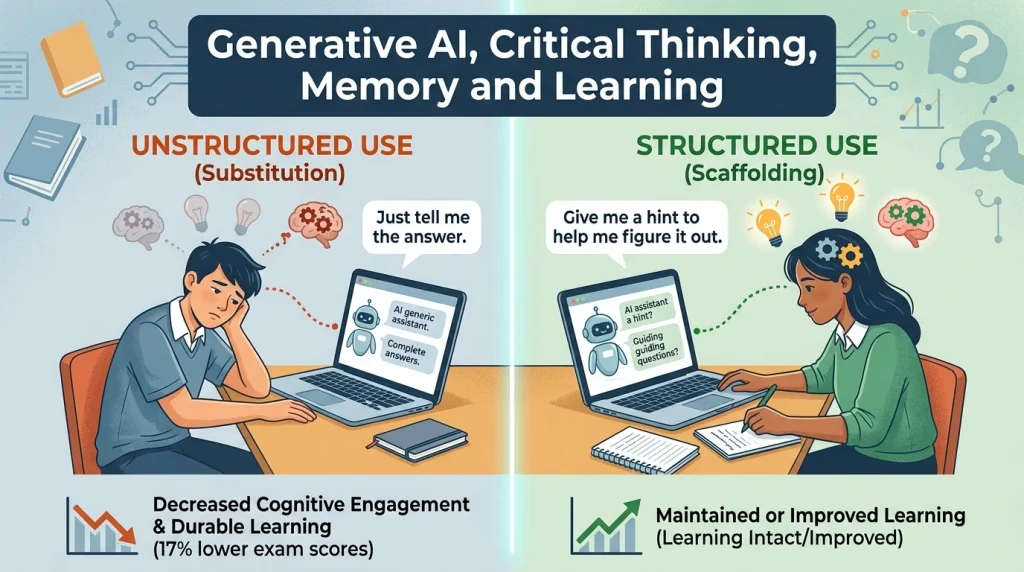
The 2023-2026 literature does not support the alarming headline that AI is rotting people’s brains, and it does not support the reassuring headline that AI is a neutral productivity tool. What it supports is narrower and more useful: unstructured, substitution-style AI use reliably weakens the cognitive engagement that produces durable learning, while structured, scaffolded AI use leaves learning intact or improves it. The single cleanest demonstration is a preregistered field experiment in Turkish high schools, where students given an unguarded GPT-4 tutor scored 48% better during assisted practice and then 17% worse on an unassisted exam than a control group; giving them a guarded tutor that offered hints rather than answers erased the harm entirely [1]. The harm, in other words, was not caused by the model; it was caused by the arrangement of cognitive labour between student and model. Meanwhile the field’s most feared study, the MIT “cognitive debt” EEG preprint, is a small, unreviewed, methodologically contested experiment [2] [3]. The experts agree far more than the coverage suggests on the mechanism (unreflective offloading is the risk) and disagree sharply on the magnitude and even the sign of the average effect. The practical answer for an ordinary user is therefore not abstinence and not boosterism: it is a small set of habits — attempt the task yourself first, use the AI for retrieval rather than argument-generation, build your own answer, then use the AI as a critic of that answer, verify claims in proportion to the stakes, and periodically do the thing unaided — that convert a substitution tool into a scaffold.
1. The 2023-2026 Evidence Base and How to Read It
Primer: the studies in this field come in very different qualities, and reading them without sorting by quality is the fastest way to be misled. This section explains the sorting.
The 2023-2026 literature on AI, thinking and learning is unusually easy to misread, for four structural reasons.
First, the field is preprint-heavy and moving faster than peer review. Of the 2026-dated studies that drive the current debate, several are not yet peer-reviewed at all: the MIT Media Lab “Your Brain on ChatGPT” EEG study is an arXiv preprint [2], the “cognitive redistribution” rebuttal is a 2026 Zenodo preprint [4], the null-result grade analysis covering 4,489 student projects is a Research Square preprint posted 21 April 2026 [5], and the 52-study meta-analysis reporting g = 1.193 is likewise a preprint [6]. Where a 2026 claim appears in this report it is labelled as preprint or peer-reviewed. A reader should treat an unreviewed result as a hypothesis with data behind it, not as a finding.
Second, the same question has produced meta-analytic estimates that disagree by a factor of nearly two. A peer-reviewed 2026 meta-analysis of 35 experimental studies (N = 4,193) reports an overall effect on learning outcomes of Hedges g = 0.670, with a subgroup effect on critical thinking of g = 1.008 [7]. A preprint meta-analysis of 52 studies reports g = 1.193 for academic achievement — but with I² = 98.0%, tau² = 2.98, and a 95% prediction interval running from −2.267 to 4.639, which is a statistical way of saying that a future comparable setting could plausibly show anything from serious harm to enormous benefit [6].
And a third meta-analysis of 51 studies, reporting g = 0.867, was retracted on 22 April 2026 because the editor found discrepancies in the meta-analysis that “undermine the Editor’s confidence in the validity” of its analysis and conclusions, with the authors failing to respond to the publisher’s correspondence [8] [9]. A reader who encounters the claim that the evidence says AI raises achievement by g = 0.867 should recognise a retracted number, and a reader who encounters g = 1.193 should ask for the prediction interval before the point estimate. The defensible description of the state of play is: positive on average, extremely heterogeneous, and unstable to inclusion criteria.
Third, small-N, short-horizon, self-report studies dominate the evidence a casual reader is most likely to meet. The MIT EEG study ran 54 participants, only 18 of whom completed the critical fourth session [2]. The Microsoft Research / CMU study of knowledge workers surveyed 319 people and analysed 936 task examples — robust as surveys go, but still self-report [10]. The Gerlich offloading study surveyed 666 people cross-sectionally [11]. A 35-study meta-analysis whose authors themselves note that studies of short duration dominate the experimental evidence base cannot tell us much about durable learning [7]. Methodological detail is not pedantry here: it is the difference between a study that can observe long-term cognitive change and a study that can only photograph a moment.
Fourth, and most important, cross-sectional designs cannot establish causation, and reverse causality is a serious rival explanation in almost every headline finding. When a cross-sectional survey reports that frequent AI users have weaker critical thinking, there are at least three explanations consistent with the same data: AI use eroded critical thinking; people with weaker critical thinking are more inclined to reach for AI; or a third factor — time pressure, workload, lower prior attainment, a surface-learning disposition — drives both. This is not a hypothetical objection. The reporting around the Gerlich study carries the study’s own caveat, in the author’s words: “The study highlights correlations rather than direct causation,” and notes that “individuals with weaker critical thinking skills are simply more inclined to rely on AI tools in the first place”. The finding is also strongest among 17-25-year-olds, who simply use AI more [12]. Any report that presents a correlation from a cross-sectional survey as proof that AI damaged someone’s thinking has skipped the one step that matters.
Holding all four cautions in mind, the analysis turns on a single spine: the distinction between measured performance and durable learning. Performance is what you can do with the tool in hand; durable learning is what you can do without it, later, on your own. Almost every apparent contradiction in this literature dissolves once you ask which of the two a given study measured. Two pre-window works are cited throughout as foundations rather than as 2023-2026 findings: Sparrow, Liu and Wegner’s 2011 “Google Effects on Memory,” which established that expecting future access to information lowers recall of the information itself while enhancing recall of where to find it [13], and Neil Selwyn’s 2022 cautionary notes on AI and education [14]. Both predate the window and are labelled as such wherever they appear.
2. Effects on Critical Thinking
Primer: on critical thinking the studies disagree most loudly, and the disagreement is largely an artefact of what each study measured — a felt change in effort, a measured test score, or a sniff test of who is using AI more.
Three credible studies, three different answers. In a peer-reviewed survey of 319 knowledge workers contributing 936 real-world examples, GenAI tools shifted the nature of critical thinking toward “information verification, response integration, and task stewardship,” and participants perceived critical thinking to require less effort overall when using the tool [10]. Crucially, the direction of the effect depended on where confidence sat: higher confidence in the GenAI tool was associated with less critical thinking, while higher self-confidence was associated with more. That is a mechanism statement, and it is one of the strongest interpretive findings in the corpus: what predicts engagement is not the tool but the user’s stance toward it.
The most-cited pro-atrophy study points the other way. Gerlich’s 2025 survey of 666 participants, published in Societies, found a significant negative correlation between frequent AI tool use and critical thinking, mediated by cognitive offloading: the total effect was b = −0.42 (SE = 0.08, p < 0.001), the indirect effect through offloading b = −0.25 (SE = 0.06, p < 0.001), and the direct effect b = −0.17 (SE = 0.05, p < 0.01) — a partial mediation, meaning offloading explains roughly 60% of the association and a direct path remains [11]. Higher education was protective, and younger participants showed both more AI use and lower scores. This is the study that generated the “AI weakens critical thinking” headlines, and it is the study most vulnerable to the reverse-causality objection above.
The direct empirical contradiction is a 2026 peer-reviewed study of 480 medical students, which found AI-based educational technology use positively correlated with critical thinking (r = 0.46, p < 0.01) and with self-regulated learning (r = 0.48, p < 0.01), with cognitive load acting as a positive mediator: more AI use was associated with reduced cognitive load, and reduced cognitive load was associated with improved critical thinking [15]. This study is explicitly cross-sectional and self-report, and its own authors say no causal claim can be drawn — the same limitation that undercuts Gerlich, applied symmetrically.
How should a careful reader adjudicate between two cross-sectional studies that point in opposite directions? The honest answer is that neither can win on design alone, and the tie-break comes from three considerations. First, populations differ: Gerlich’s sample is a broad UK convenience sample across ages, the medical-students study is a narrow, self-selected, academically strong cohort averaging about 21 years old, for whom AI use may genuinely function as a study aid rather than a substitute for thinking. Second, the mediator’s sign flips between them — cognitive load is treated as harmfully avoided in one and helpfully reduced in the other, which is a sign that “cognitive load” is being used to mean two different things (the productive struggle of learning versus the incidental friction of a badly designed task). Third, the mechanism both studies share — offloading — is the variable that actually predicts outcomes, which pushes the analysis toward the dependent-versus-autonomous offloading distinction discussed below rather than toward a verdict on AI in general.
The San Francisco-adjacent spectre of brain damage does not survive contact with the EEG evidence. The MIT “cognitive debt” study reported that participants using an LLM showed the weakest and least distributed brain connectivity, while brain-only participants showed the strongest, and that LLM users reported the lowest sense of essay ownership and struggled to quote their own work [2]. But this is a preprint whose own authors state that “all the conclusions are to be treated with caution and as preliminary,” that peer review “will probably take months,” that they recruited from a narrow geographic area, that results cannot be generalised to other LLMs, that the findings are context-dependent to essay writing, and that journalistic words like “dumb,” “brain rot” and “damage” do a disservice to the work [16].
A formal academic rebuttal preprint argues the study is statistically underpowered — a GPower a priori analysis for its design implies roughly N = 159 participants were needed against the 54 used — that a “significant connection” was defined merely as a relative group difference so fewer connections cannot be read as weaker absolute neural activity, that the EEG direction was in fact inconsistent (counting significant connections the same way, the LLM condition showed greater* beta-band engagement in some comparisons), and that the Search-Engine group relied on an external tool yet showed no impairment [3]. A separate independent critique adds that the EEG analysis ran rmANOVA across 1024 electrode pairs up to 1000 times each, a severe multiple-comparisons problem likely to produce hundreds of chance significances even with false-discovery-rate correction [17]. This is not a study a careful reader should cite as evidence of cognitive harm.
The most analytically useful reframing in the corpus comes from a 2026 peer-reviewed three-wave study of 589 participants that distinguishes dependent cognitive offloading (delegating core thinking to the AI) from autonomous cognitive offloading (using the AI as a scaffold while retaining cognitive agency) [18]. Dependent offloading was positively associated with cognitive-agency transfer and negatively with intrinsic motivation, which in turn linked to poorer perceived outcomes; autonomous offloading was positively associated with intrinsic motivation and more favourable outcomes. Two details make this finding unusually important. First, both modes deliver comparable immediate benefits, which suggests that “potentially maladaptive AI engagement may be difficult for users to detect from immediate experience” — the user cannot feel the difference in the moment. Second, metacognitive monitoring attenuated the link between dependent offloading and agency transfer. This is the clearest statement in the literature of why the honest answer on whether AI is bad for critical thinking is that it depends on the arrangement, and you cannot feel which arrangement you are in.
The strongest version of the anti-atrophy case is that a measurable fraction of people, under conditions of high trust in AI and low self-confidence, are offloading the thinking that critical thinking consists of, and the immediate experience of using AI does not tell them this is happening. The strongest version of the pro-AI case is that critical thinking is not obviously falling, that the loudest study is methodologically fragile, and that the average effect of well-structured AI use on higher-order outcomes is positive. Both are true, and they are compatible, because the average is positive while the tail of unreflective use is negative. The policy any ordinary person should draw is not about AI but about which end of that distribution they occupy.
3. Effects on Memory
Primer: memory is where the alarm is loudest and the evidence thinnest — because the study most often cited does not measure memory at all in a way that supports the alarm.
The concern about memory has a long pedigree that predates the current window. Sparrow, Liu and Wegner’s 2011 work established the “Google effect”: when people expect future access to information, they have lower recall of the information itself but enhanced recall of where to access it, and the Internet functions as an external or transactive memory [13]. This is pre-window foundational work, cited by the whole 2023-2026 lineage, and it is the honest ancestor of today’s offloading discourse — it described an adaptive reallocation, not a deficit, a framing that later commentary largely dropped.
Within the window, the empirical claim that AI harms memory is carried mostly by one large study and one construct. The large study is a three-wave, time-lagged survey of 494 university students. It found that ChatGPT use predicted greater procrastination, greater self-reported memory loss, and lower academic performance, with workload and time pressure increasing the likelihood of ChatGPT use [19]. The strengths are real: three waves, a decent N, a time-lagged design that partially addresses reverse causality, and a coherent self-regulatory-failure story in which students under time pressure adopt surface learning and offload. The limits are equally real: memory loss is self-reported, the students are a single population, and time-lagged survey data still cannot rule out a common cause. A reader should treat “memory loss” here as students reporting that their memory feels worse, which is a meaningful signal about lived experience but not a measured decline in recall capacity.
The theoretical apparatus around this claim is instructive precisely because it is theory, not evidence. A 2024 opinion piece in Frontiers in Psychology proposes the construct “AI chatbots-induced cognitive atrophy” (AICICA), grounded in the extended-mind thesis and parallels with problematic internet use, and lays out four speculative mechanisms by which interactive AI could contribute to cognitive decline [20]. This is editor-reviewed opinion, useful for framing and hypotheses, not a finding. A 2025 companion opinion piece argues the real question is not whether AI is “good or bad for mental health but how it is reshaping the very architecture of coping.” It adds that AI both enables offloading and can create overload and hyper-monitoring anxiety [21]. Read together, these opinion pieces show a field where the vocabulary of harm is being constructed faster than the measurements to support it.
The most intellectually serious treatment of AI and memory within the window is a peer-reviewed conceptual article in Memory, Mind & Media (2024) arguing that generative AI “changes what memory is and what memory does”, pushing it beyond the realm of individual human influence and control while offering new modes of expression [22]. Its proposal of a “third way of memory” — one that recognises human-machine entanglement as both enabling and endangering agency — is the most useful frame available, because it refuses the false binary of cognitive threat versus neutral tool. It also raises a genuinely novel worry that the empirical literature has barely touched: that generative systems “untether the human past from the present”, producing a past that was never actually remembered in the first place, and that increasingly autonomous agents remake individual and collective pasts beyond human consent. This is a different kind of memory concern than the individual-recall worry, and it is under-evidenced.
On the empirical mechanism linking offloading to memory, the least-noticed finding in the corpus is the one that should reassure no one and alarm no one: in a peer-reviewed time-lagged SEM of 465 preservice teachers, cognitive offloading was a strong positive mediator of the link between GenAI tool use and academic achievement [23]. Read against the memory-loss framing, offloading is positive in one study and negative in another — a sign the construct is doing too much work. The dependent/autonomous distinction resolves this: a single “offloading” variable will absorb both the scaffolding that helps and the substitution that harms, which is exactly what makes the aggregate results unstable [18].
There is no credible evidence that ordinary AI use damages memory as a capacity. There is credible evidence that it changes what people encode and what they externalise, in line with the well-established Google effect, and that some users experience this as a felt loss of edge. Whether that reallocation is adaptive or corrosive depends on whether the offloaded content was peripheral to the user’s goals or constitutive of them — and, as the offloading study shows, users cannot tell from the inside which one they are doing [18].
4. Effects on Learning
Primer: learning is where the evidence is cleanest, and the finding is the most actionable thing in this report.
The learning-axis landmark is a large preregistered RCT with roughly 1,000 Turkish high-school students, published in PNAS (2025). Students given an unguarded GPT-4 tutor (“GPT Base”) performed statistically significantly worse on an unassisted exam than the control group — by 17% — while scoring 48% better during the assisted practice sessions [1]. Students given a guarded tutor (“GPT Tutor”) that offered hints rather than answers saw practice gains of 127%, and — the crucial result — the negative exam effect was “essentially eradicated,” with exam performance statistically indistinguishable from the control.
The mechanism was substitution, not misinformation: students used GPT Base as “a ‘crutch’ by asking for and copying solutions,” interacted substantially less with the tool than GPT Tutor users, and did not perceive that they had learned less. The authors tested whether the model’s errors misled students — GPT Base gave a correct answer only 51% of the time, with logical errors 42% and arithmetic errors 8% — and found no spillover to exam performance, consistent with copying rather than confusion. They also demonstrated that AI reduced the skill gap on practice problems (grade dispersion fell) but that the reduction did not persist on the unassisted exam: the appearance of equalisation was an artefact of assistance.
This study is the analytical spine of this report because it separates the two quantities that the rest of the literature conflates. The practice-session gain (+48%) is performance; the exam drop (−17%) is learning. The two point in opposite directions, and only a design that measures both can see that. It is a single-topic (mathematics), single-site, short-horizon study using Fall-2023-era models, and the authors say so — but it is preregistered with a designated primary analysis of unassisted exam outcomes across arms, and its data and code were published openly, which makes it more trustworthy than most.
The RCT on reading comprehension points the same way, with a caveat. In a pre-registered trial of 405 students aged 14-15 in England, both note-taking alone and note-taking combined with LLM use produced significantly better retention and comprehension three days later than using the LLM alone [24]. The metacognitive finding matters as much as the learning finding: most students preferred the LLM over note-taking and perceived it as more helpful, despite worse measured learning — a miscalibration that echoes the PNAS finding that harmed students did not believe they had been harmed. This note is abstract-only, so the specific effect sizes and the “archetypes” of prompting behaviour should be treated as indicative rather than settled.
Against these substitution harms, the pro-AI learning evidence is substantial and peer-reviewed. The 35-study meta-analysis (N = 4,193) reports g = 0.670 overall, with critical thinking g = 1.008, problem-solving g = 0.933, achievement g = 0.876 and creative thinking g = 0.633, no significant publication bias, and a pooled effect robust to leave-one-out and small-sample exclusions (range 0.628-0.696) [7]. A peer-reviewed Scientific Reports time-lagged survey of 465 preservice teachers found GenAI tool use positively associated with academic achievement, mediated by both shared metacognition and cognitive offloading [23]. These are real positives, and the honest reading is that structured AI use in supported settings does help learning on average. What these designs cannot show is whether the gains survive the withdrawal of the tool — which is precisely the question the PNAS RCT was built to answer, and which it answered negatively for unguarded use.
The weakest link in the positive case is the null study. A preprint analysis of 4,489 student projects from 2022-2025 found that declared AI use was “not systematically associated with higher or lower marks” once contextual factors were controlled for, while prior performance, attempt number, linguistic complexity and submission length were robust predictors [5]. This is a preprint and covers a different outcome (grades on real coursework rather than experimental tests), but it is the single largest dataset in the corpus and it finds nothing, which is an important check on the enthusiasm the meta-analyses invite.
Two studies in this space could not be verified and are reported here only to be excluded from the argument. A Journal of Computer Information Systems study (reported as n = 625) is claimed to show that AI usage negatively predicts critical thinking with trust amplifying and AI literacy buffering the effect; the full text was not obtainable, and it should not be relied on. The same applies to an Interactive Learning Environments report of an eight-week metacognitive-scaffolding intervention (reported as n = 85): only the publisher’s access page was retrieved, so any figure attached to it is unverified [25] [26]. A frequently repeated retention figure (a 120-student, 45-day study reporting 57.5% versus 68.5% retention, d = 0.68) came from a search summary rather than a fetched source and is likewise not presented here as verified.
Finally, one early review is useful for perspective rather than evidence. A peer-reviewed 2024-25 review of the first months of higher-education discourse identified ten claims that framed AI as a catalyst for existing agendas rather than a rupture, portrayed students chiefly as “either plagiarists or victims of a failing educational system,” and noted a caveat about “the decoupling of thinking and writing” [27]. That caveat, published before the RCTs, is exactly what the PNAS experiment later tested.
AI reliably improves performance when used in the moment, and reliably improves durable learning only when it is arranged not to substitute for the learner’s own processing. The PNAS guardrail result is the load-bearing fact: the same model that harmed learning when it gave answers left learning unharmed when it gave hints. The tool was constant; the arrangement changed.
5. Where the Evidence Converges
Primer: strip away the headline fights and a surprising amount is agreed upon.
Beneath the contradictions, five propositions command broad agreement across the peer-reviewed literature.
The risk travels through offloading, not through AI as such. Gerlich’s mediation, the medical-students study’s mediation, the dependent/autonomous offloading study, the Educational Psychology Review framework, and the CHI knowledge-worker study all circle the same construct [11] [15] [18] [28] [10]. The framework paper states the consensus most precisely: the effect of GenAI is “a property of the partition of cognitive labor between learner and machine,” and offloading augments learning when it discharges operations peripheral to the learning goal but risks erosion when it bypasses processing constitutive of it [28].
Self-regulation and self-confidence are the moderators that matter. The medical-students study found self-regulated learning buffered the negative influence of cognitive load [15]; the dependent/autonomous study found metacognitive monitoring attenuated the link between dependent offloading and agency transfer [18]; the CHI study found higher self-confidence predicted more critical thinking and higher AI confidence predicted less [10]; and a peer-reviewed SEM of 223 higher-education students found that ease of use enhanced self-regulation, which in turn improved critical thinking and problem-solving, while perceived usefulness and learning value did not — concluding that AI tools “can offer an environment conducive to developing higher-order cognitive skills” without that necessarily translating into better skills — self-regulation, not the tool, is the active ingredient [29].
The felt experience is a poor guide to the learning outcome. Both the PNAS RCT (students who learned less did not believe they had) and the note-taking RCT (students preferred the tool that produced worse retention) show a metacognitive miscalibration, and the offloading study explains why: both offloading modes deliver comparable immediate benefits, so the user cannot detect the maladaptive one from the inside [1] [24] [18].
Relief and offloading are different mechanisms and pull in opposite directions. A peer-reviewed study of 287 university students found that cognitive relief is a complementary mediator between AI use and positive attitudes, whereas cognitive offloading is a competitive mediator, with the two producing opposing effects [30]. This is the cleanest available statement that AI making learning feel easier and AI making learning better are separate claims, and that the first does not imply the second.
Students’ own beliefs have shifted toward the skeptical view. In RAND’s non-peer-reviewed 2026 survey, the share of US students using AI for homework rose from 48% in May 2025 to 62% in December 2025. Over the same ten months, the share agreeing that “the more students use AI for their schoolwork, the more it will harm their critical thinking skills” rose to 67%, up more than ten points, with about 60% of AI-using students expressing concern about their own use [31]. This is perception, not evidence of harm, but it establishes that the anxiety is now mainstream among the people actually using the tools.
A note of convergence on method: the corpus repeatedly calls for the same missing study — experimental manipulation of AI use with measures of resultant change in critical thinking, and long-horizon designs that can distinguish durable learning from assisted performance [11] [7]. The field knows what it lacks.
6. Where the Experts Contradict Each Other
Primer: the disagreements are real, and stating them at full strength is the only way to see what would settle them.
Contradiction one: AI associated with lower versus higher critical thinking, both cross-sectional. Gerlich’s 666-participant survey found a negative association, partially mediated by offloading, strongest in the young [11]. The 2026 medical-students study found a positive association (r = 0.46) with cognitive load as a positive mediator [15]. Both are cross-sectional, both rely on self-report, and each is exposed to precisely the reverse-causality critique the other can raise. Neither can defeat the other on design. The most defensible position is that the two studies are measuring different things in different populations — the difference in mediator sign (load avoided as harm versus load reduced as help) suggests the disagreement is partly linguistic. What would settle it: a longitudinal or experimental design in both populations measuring offloading type and outcome separately.
Contradiction two: the EEG “cognitive debt” finding versus its formal rebuttal. Kosmyna et al. report that LLM users showed the weakest brain connectivity, lowest ownership and poorest self-quoting [2]. Stanković et al. reply that the study needed roughly N = 159 for adequate power and used 54; that “significant connection” is only a relative group difference; that the EEG direction was inconsistent and in some comparisons favoured the LLM condition; that the Search-Engine group also offloaded yet showed no impairment and the Search-Engine-versus-Brain-Only quoting comparison was non-significant (p = 1); and that “cognitive agency” and value claims were overinterpreted from questions about perceived authorship [3]. The study’s own authors concede the preprint status and warn against the brain-rot narrative [16], and an independent commentary flags the multiple-comparisons problem [17]. What would settle it: a properly powered preregistered replication with a pre-specified connectivity analysis and an internal-tool (non-LLM) active control the LLM group must match.
Contradiction three: positive meta-analyses versus the null grade dataset. The peer-reviewed 35-study meta-analysis finds a robust positive average effect [7] and the preprint 52-study meta-analysis finds a larger one [6], while the 4,489-project preprint finds no effect of declared AI use on real grades once context is controlled [5]. The reconciliation is structural rather than statistical: meta-analyses pool short, task-specific experimental outcomes (performance), while the grade dataset observes coursework in naturalistic conditions (a mix of performance and learning, contaminated by effort, integrity and coursework design). What would settle it: pre-registered experiments with delayed unassisted outcome measures deployed inside real courses.
Contradiction four: the three-way meta-analytic spread. The same broad question yields g = 0.670 [7], g = 1.193 [6], and g = 0.867 [8] [9] — three comparable-looking numbers whose provenance differs sharply:
| Estimate | Status | Key caveat |
|---|---|---|
| g = 0.670 | Peer-reviewed, 35 studies | Robust to leave-one-out |
| g = 1.193 | Preprint, 52 studies | I² = 98.0%; prediction interval −2.267 to 4.639 |
| g = 0.867 | Retracted 22 April 2026, 51 studies | Authors non-responsive |
Any reader who quotes a single number from this spread as “the effect of AI on learning” is quoting an inclusion criterion, not a fact. The retracted g = 0.867 in particular should never be cited as a valid effect size; it is cited here only as a cautionary case about how quickly a plausible-looking pooled number can travel before it is checked.
Contradiction five: whether the whole decline narrative is a category error. The “cognitive redistribution” preprint argues that the studies driving the decline story share the same defects — small samples, no longitudinal data, correlational designs, and instruments that conflate reduced effort with impairment — and that they document “the atrophy phase of a cognitive transition,” not permanent decline, echoing a recurring 2,400-year techno-cognitive panic from Socrates’ critique of writing [4]. This is a preprint and abstract-only, so it is a thesis rather than a demonstration, but the methodological critique it lodges is the same one this report has applied to every headline study, and it is not wrong.
The field’s disagreements are not primarily about whether offloading matters — they are about whether the particular offloading that AI encourages is adaptive reallocation or corrosive substitution, and about whether the average effect on measured outcomes is positive, null, or negative. The evidence presently permits all three answers depending on arrangement, population and horizon. A reader should therefore distrust any single study’s verdict and trust the mechanism, which is stable.
7. What an Ordinary User Should Actually Do
Primer: everything above reduces to a handful of habits that are cheap to adopt and that the evidence says actually protect learning.
The prescriptive section rests on one experimental result and one framework. The experiment: a peer-reviewed study of 150 participants (and 450 evaluated responses) found that unguided AI use “fosters cognitive offloading without improving reasoning quality, whereas structured prompting significantly reduces offloading and enhances both critical reasoning and reflective engagement” [32]. The framework: regulate offloading rather than abstain from AI, keeping the partition of labour such that the machine handles the peripheral and the human handles the constitutive [28]. The dependence/autonomy distinction supplies the target: aim for autonomous offloading — AI as scaffold — and avoid dependent offloading — AI as substitute [18].
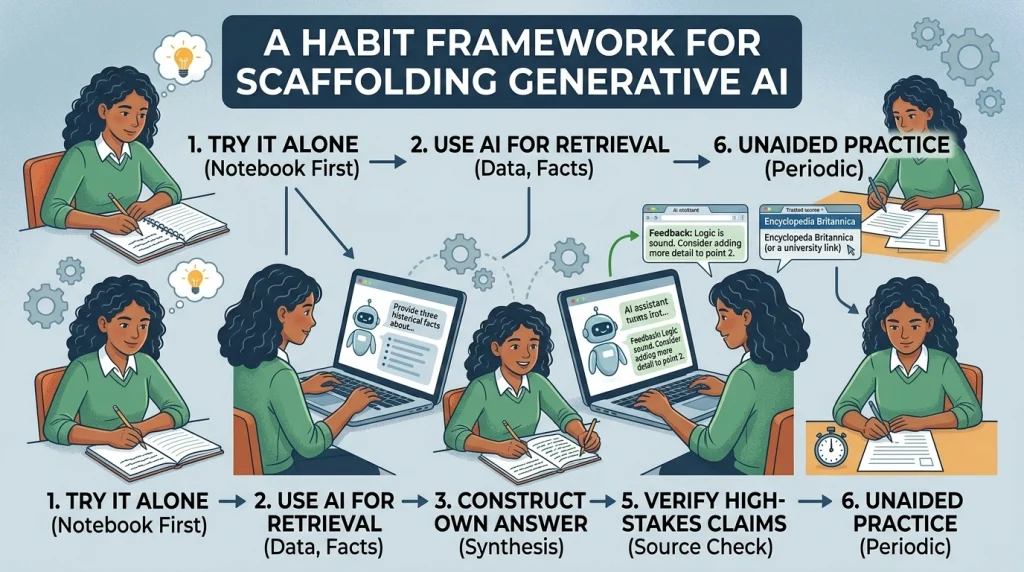
The evidence offers a specific five-step protocol from the structured-prompting experiment — initial reflection, targeted research use, argument construction, critical review, and final reflection — which maps onto six ordinary practices [32]. Rendered into ordinary practice:
1. Attempt the task yourself first, before opening the AI. Write your own one-paragraph answer, sketch, or plan — however rough. This mirrors the “initial reflection” step, and it is the single highest-leverage habit, because it converts the AI from a substitute into a critic. The PNAS result is the reason: harm arose when students began by obtaining solutions, and disappeared when they were pushed to attempt answers first [1].
2. Use the AI for retrieval and orientation, not for generating your argument. Ask it for sources, definitions, counter-examples, and the shape of a debate. This is the “targeted research use” step, and it is the mode the knowledge-worker study found reduces effort on knowledge and comprehension without eroding the higher-order work [10].
3. Construct your own answer after retrieval and before critique. The “argument construction” step. The evidence is direct that the higher-order operations — analysis, synthesis, evaluation — are the ones AI most easily removes, and the ones whose removal most damages learning [10] [28]. If you delegate them, you are offloading constitutively.
4. Then use the AI as a critic of your answer. Hand it your own argument and ask what is weak, what is unsupported, what a hostile reader would say. This is the “critical review” step and the essence of autonomous offloading: the human retains agency, the machine stress-tests [18]. A guarded tutor that probes rather than answers is exactly what erased the PNAS harm [1].
5. Verify claims in proportion to the stakes. For a shopping list, no verification. For a medical decision, a legal document, or a claim you intend to publish, verify against a primary source, because the models are unreliable — GPT Base was factually correct only 51% of the time in the PNAS study [1]. The knowledge-worker study shows this is where critical thinking now lives: “information verification, response integration, and task stewardship” [10].
6. Periodically do the thing unaided. Once a week, or once a month, do the task the AI usually helps with, entirely alone, and notice whether it got harder. This is the only way to detect the miscalibration the studies describe, since neither the AI nor your feelings will tell you [24] [18].
Two structural precautions follow from the convergence evidence. First, protect and train your self-regulation, not your tool choice: the self-regulation study found it, not ease of use or perceived usefulness, was what converted AI access into better critical thinking [29]. Set a prior decision about what you will and will not delegate, and check it for the two failure modes — like the medical students who used AI as a study aid within a demanding curriculum, or the time-pressured who reached for it as a self-regulatory escape [19]. Second, remember that relief is not learning: the study of 287 students found relief and offloading pull in opposite directions, and relief feels better [30]. If AI makes studying feel effortless, that is a warning sign, not a win.
For parents, teachers and institutions, the same logic scales. RAND’s own recommendation is that schools “identify use cases in which AI use primarily leads to cognitive offloading” rather than to cognitive augmentation [31], and the PNAS RCT supplies the design principle: build AI tutors that probe for misconceptions and offer hints rather than answers, and prefer tools that engage the student proactively rather than answering on demand [1]. The early higher-education review’s warning against uncritical adoption still stands [27], as does Selwyn’s insistence that AI in education be treated as a political choice with unequal effects rather than a neutral tool [14].
What users should not do is equally important. Do not conclude from the fear literature that you are damaging yourself — the strongest single study offered as evidence of harm is an unreviewed, underpowered, methodologically contested preprint [2] [3], and the strongest claim of memory damage is self-reported [19]. Nor should you conclude that AI is a neutral productivity multiplier — the substitution literature shows it removes cognitive labour in ways the user cannot feel. The mature stance is neither technophobia nor boosterism but stewardship of the partition of labour: decide deliberately what the machine does and what remains yours.
Forward-looking: what would change this advice, and why the stakes rise
Three near-term developments could move the evidence, and users should watch for them.
- New study designs. The arrival of the studies the field keeps asking for: preregistered experiments with delayed unassisted outcome measures inside real classrooms, and longitudinal designs long enough to say whether any reallocation is adaptive or corrosive [7] [11]. When those land, the prescriptive advice above may harden or loosen, but its shape — attempt first, scaffold not substitute, verify to the stakes — is unlikely to change, because it targets the mechanism rather than the tool.
- AI as infrastructure. The maturing of AI as infrastructure rather than an app you choose to open. The Hoskins argument that generative systems, and increasingly autonomous agents, remake memory and the past beyond individual consent suggests that the individual habits above, necessary as they are, will not by themselves protect collective cognition; that is a governance question, not a personal one [22].
- More reliable models. The possibility that models become reliable enough (far above the 51% seen in 2023) that verification burdens fall and the substitution economy shifts. Were that to happen, the balance of peripheral versus constitutive operations would move, but the principle would not: whatever the machine can reliably do is exactly the task whose removal from your own practice will weaken you.
The reason the stakes are rising rather than falling is demographic. AI-in-homework use among students jumped from 48% to 62% in seven months, and two-thirds of students now believe it harms their thinking [31]. The population at the highest-risk developmental stage is therefore adopting the highest-risk usage pattern — unguided, substitution-style, before the habits that would make it safe are formed. The university surveys show these users are not naive; they know there are risks [33][34]. What the evidence suggests they lack is not awareness but a usable protocol — one grounded in the best-designed study in the literature rather than in the loudest.
The honest summary of 2023-2026 is therefore neither alarm nor reassurance. It is a warning about a specific failure mode — delegating the thinking that is the point — and a demonstration that the same tool becomes safe when the delegation is confined to what is not the point. The evidence cannot yet tell us the average long-run effect on a whole generation. It can tell us, with unusual clarity for this field, which configuration produces harm and which does not. That is enough to act on.
Sources
- Hamsa Bastani et al. (2025). Generative AI without guardrails can harm learning: Evidence from high school mathematics. Proceedings of the National Academy of Sciences. https://doi.org/10.1073/pnas.2422633122 (read at https://www.ebi.ac.uk/europepmc/webservices/rest/PMC12232635/fullTextXML) [1]
- [2506.08872] Your Brain on ChatGPT: Accumulation of Cognitive Debt when Using an AI Assistant for Essay Writing Task. https://ar5iv.labs.arxiv.org/html/2506.08872 [2]
- Miloš Stanković et al. (2025). Comment on: Your Brain on ChatGPT: Accumulation of Cognitive Debt When Using an AI Assistant for Essay Writing Tasks. arXiv:2601.00856 [3]
- Anthony Lee (2026). Cognitive Redistribution, Not Cognitive Decline: A Critical Review of Studies Linking AI Chatbot Use to Diminished Cognition. Zenodo (CERN European Organization for Nuclear Research). https://doi.org/10.5281/zenodo.18653041 [4]
- Mareike Mueller et al. (2026). Grade Expectations: Generative AI Use Does Not (Yet) Alter Student Achievement. Research Square. https://doi.org/10.21203/rs.3.rs-9053629/v1 (read at https://www.researchsquare.com/article/rs-9053629/latest.pdf) [5]
- Xiuxiu Tang et al. (2025). Transforming Learning or Empty Promise? A Meta-Analysis of Generative AI in Education. Research Square. https://doi.org/10.21203/rs.3.rs-7577394/v1 (read at https://www.researchsquare.com/article/rs-7577394/latest.pdf) [6]
- Xinning Wu et al. (2026). ChatGPT’s impact on student learning outcomes: a meta-analysis of 35 experimental studies. Humanities and Social Sciences Communications. https://doi.org/10.1057/s41599-026-07019-z [7]
- Jin Wang and Wenxiang Fan (2026). Retraction Note: The effect of ChatGPT on students’ learning performance, learning perception, and higher-order thinking: insights from a meta-analysis. Humanities and Social Sciences Communications. https://doi.org/10.1057/s41599-026-07310-z [8]
- Jin Wang and Wenxiang Fan (2025). RETRACTED ARTICLE: The effect of ChatGPT on students’ learning performance, learning perception, and higher-order thinking: insights from a meta-analysis. Humanities and Social Sciences Communications. https://doi.org/10.1057/s41599-025-04787-y [9]
- Hao-Ping (Hank) Lee et al. (2025). The Impact of Generative AI on Critical Thinking: Self-Reported Reductions in Cognitive Effort and Confidence Effects From a Survey of Knowledge Workers. CHI ’25 (ACM), Article 1121, pp. 1-22. https://www.microsoft.com/en-us/research/wp-content/uploads/2025/01/lee_2025_ai_critical_thinking_survey.pdf [10]
- AI Tools in Society: Impacts on Cognitive Offloading and the Future of Critical Thinking. https://www.mdpi.com/2075-4698/15/1/6 [11]
- AI tools may weaken critical thinking skills by encouraging cognitive offloading, study suggests. https://www.psypost.org/ai-tools-may-weaken-critical-thinking-skills-by-encouraging-cognitive-offloading-study-suggests/ [12]
- Betsy Sparrow et al. (2011). Google Effects on Memory: Cognitive Consequences of Having Information at Our Fingertips. Science. https://doi.org/10.1126/science.1207745 [13]
- Neil Selwyn (2022). The future of AI and education: Some cautionary notes. European Journal of Education. https://doi.org/10.1111/ejed.12532 (read at https://research.monash.edu/en/publications/e9571b77-8d7a-45e3-86f9-a7b23372bee2) [14]
- Arooj Arshad et al. (2026). From AI use to critical thinking among medical students: a moderated mediation perspective on cognitive load and self-regulated learning. Frontiers in Psychology. https://doi.org/10.3389/fpsyg.2026.1883053 [15]
- Overview ‹ Your Brain on ChatGPT — MIT Media Lab. https://www.media.mit.edu/projects/your-brain-on-chatgpt/overview/ [16]
- Gary Smith (2025). The p-hacking of the ChatGTP wolves. prior probability (blog). https://priorprobability.com/2025/06/27/the-p-hacking-of-the-chatgtp-wolves [17]
- (2026). Not all cognitive offloading is equal: distinguishing dependent and autonomous offloading to generative AI. Frontiers in Psychology. https://doi.org/10.3389/fpsyg.2026.1878629/full [18]
- Muhammad Abbas et al. (2024). Is it harmful or helpful? Examining the causes and consequences of generative AI usage among university students. International Journal of Educational Technology in Higher Education. https://doi.org/10.1186/s41239-024-00444-7 [19]
- Ismail Dergaa et al. (2024). From tools to threats: a reflection on the impact of artificial-intelligence chatbots on cognitive health. Frontiers in Psychology. https://doi.org/10.3389/fpsyg.2024.1259845 (read at https://www.frontiersin.org/journals/psychology/articles/10.3389/fpsyg.2024.1259845/pdf) [20]
- Ginto Chirayath et al. (2025). Cognitive offloading or cognitive overload? How AI alters the mental architecture of coping. Frontiers in Psychology. https://doi.org/10.3389/fpsyg.2025.1699320 (read at https://public-pages-files-2025.frontiersin.org/journals/psychology/articles/10.3389/fpsyg.2025.1699320/pdf) [21]
- Andrew Hoskins (2024). AI and memory. Memory Mind & Media. https://doi.org/10.1017/mem.2024.16 (read at https://www.cambridge.org/core/services/aop-cambridge-core/content/view/BB2E4B113B826133E1B6C8DB6BACD192/S263502382400016Xa.pdf/div-class-title-ai-and-memory-div.pdf) [22]
- Javed Iqbal et al. (2025). Generative AI tool use enhances academic achievement in sustainable education through shared metacognition and cognitive offloading among preservice teachers. Scientific Reports. https://doi.org/10.1038/s41598-025-01676-x [23]
- Effects of LLM Use and Note-Taking On Reading Comprehension and Memory: A Randomised Experiment in Secondary Schools – Microsoft Research. https://www.microsoft.com/en-us/research/publication/effects-of-llm-use-and-note-taking-on-reading-comprehension-and-memory-a-randomised-experiment-in-secondary-schools/ [24]
- Rongqing Zhuo and Zhongxian Bai (2026). Mitigating cognitive offloading in GenAI-supported collaboration: a metacognitive scaffolding approach to enhancing students’ critical thinking. Interactive Learning Environments. https://doi.org/10.1080/10494820.2026.2697043 [25]
- Abhinandan Kulal (2025). Cognitive Risks of AI: Literacy, Trust, and Critical Thinking. Journal of Computer Information Systems. https://doi.org/10.1080/08874417.2025.2582050 [26]
- Lasse X Jensen et al. (2024). Generative AI and higher education: a review of claims from the first months of ChatGPT. Higher Education. https://doi.org/10.1007/s10734-024-01265-3 [27]
- Daiki Nakamura (2026). Augmentation or Erosion? Regulating Cognitive Offloading in Generative AI-Supported STEM Learning. Educational Psychology Review. https://doi.org/10.1007/s10648-026-10224-6 [28]
- Xue Zhou et al. (2024). The Mediating Role of Generative AI Self-Regulation on Students’ Critical Thinking and Problem-Solving. Education Sciences. https://doi.org/10.3390/educsci14121302 [29]
- Wenqiang Fan et al. (2026). In-Class AI Use and Attitudes Among University Students: The Different Mediating Roles of Cognitive Relief and Cognitive Offloading. Behavioral Sciences. https://doi.org/10.3390/bs16061014 (read at https://pubmed.ncbi.nlm.nih.gov/42352847/) [30]
- More Students Use AI for Homework, and More Believe It Harms Critical Thinking: Selected Findings from the American Youth Panel | RAND. https://www.rand.org/pubs/research_reports/RRA4742-1.html [31]
- Michael Gerlich (2025). From Offloading to Engagement: An Experimental Study on Structured Prompting and Critical Reasoning with Generative AI. Data. https://doi.org/10.3390/data10110172 [32]
- Cecilia Ka Yuk Chan and Wenjie Hu (2023). Students’ voices on generative AI: perceptions, benefits, and challenges in higher education. International Journal of Educational Technology in Higher Education. https://doi.org/10.1186/s41239-023-00411-8 (read at https://arxiv.org/pdf/2305.00290) [33]
- Clare Baek et al. (2024). “ChatGPT seems too good to be true”: College students’ use and perceptions of generative AI. Computers and Education Artificial Intelligence. https://doi.org/10.1016/j.caeai.2024.100294 (read at https://escholarship.org/content/qt2gf4p9hh/qt2gf4p9hh.pdf) [34]