
AI disclosure: This article contains AI-generated content. It was drafted with the help of an AI assistant, and its facts and sources were reviewed before publishing.
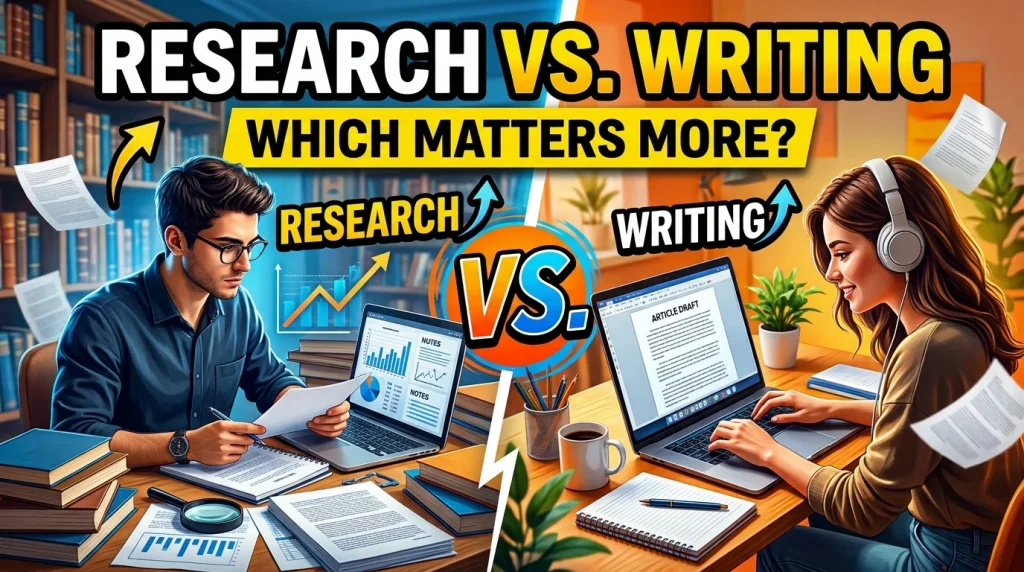
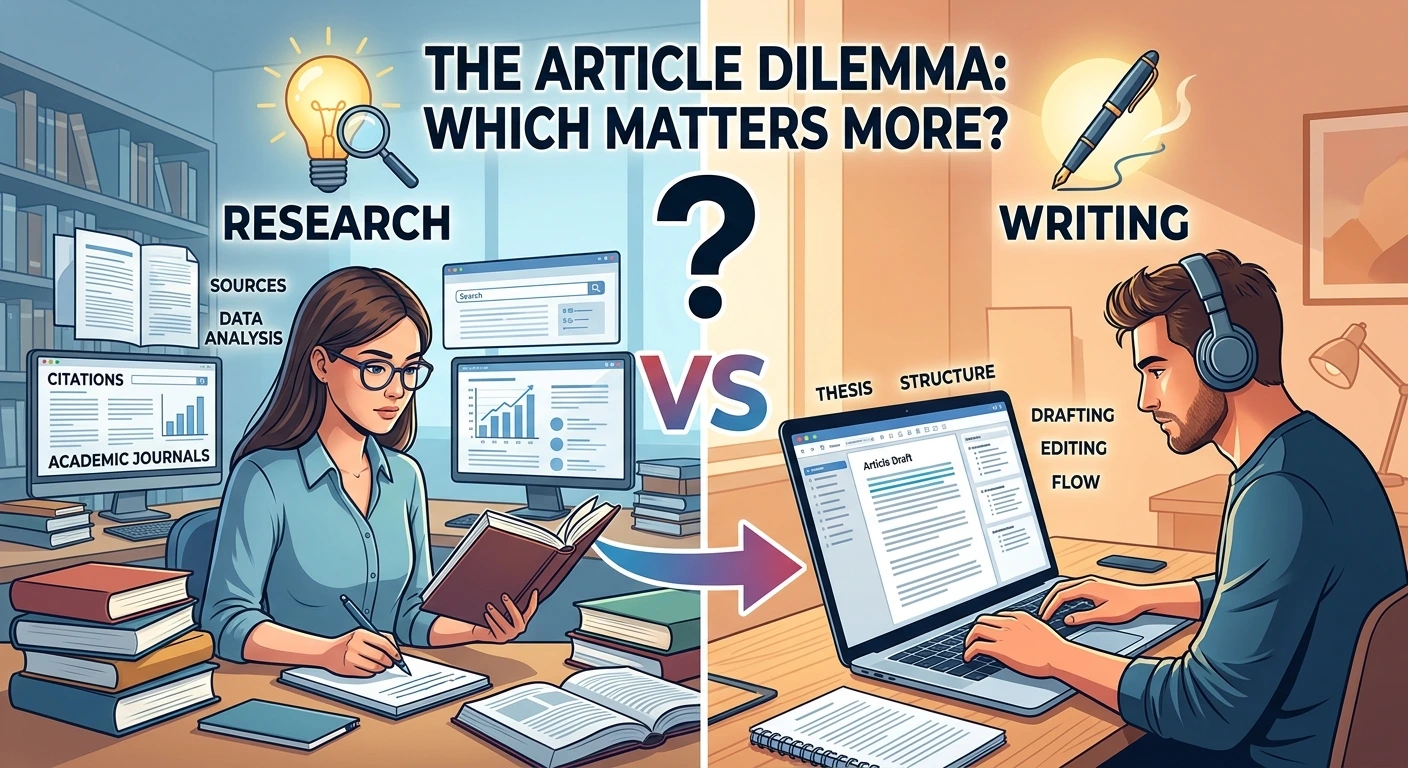
Ask ten writers whether research or writing matters more and you will get ten confident answers. The honest one is less satisfying but more useful: research decides whether an article deserves to be read; writing decides whether it actually gets read. They are not competing for the same job. One builds the thing, the other delivers it. Skimp on either and the article fails, just in different ways and at different speeds.
This piece looks at what each side really contributes, how the balance shifts with the kind of article you are writing, and why, in 2026, the research side has quietly become the one that sinks articles most often.
What research actually contributes
Research is the foundation. If the facts are wrong, thin, or recycled from the first five search results, no amount of elegant phrasing will rescue the piece. In fact, a well-written article that is wrong is worse than a clumsy one, because good prose makes errors convincing.
Solid research gives an article four things writing cannot fake:
- Accuracy. Claims that are true, numbers that match their source, quotes that were actually said.
- Depth. Primary sources rather than summaries of summaries, so the article says something the reader cannot get elsewhere.
- Balance. The counter-argument, found on purpose, so the reader knows where experts genuinely disagree.
- Credibility over time. One invented citation or misquoted statistic, once a reader spots it, can undo the trust built by a dozen good posts.
Search engines increasingly reward exactly this. Google’s guidance on creating helpful, reliable, people-first content asks publishers to check whether their content offers original information, reporting, research or analysis. That is a research question, not a style question.
What writing actually contributes
Writing is delivery. Excellent research presented in a disorganised wall of text simply does not reach anyone, because most people do not read web pages; they scan them. Nielsen Norman Group’s early usability work found that 79 percent of test users always scanned a new page and only 16 percent read it word by word, and their later eyetracking studies documented the familiar F-shaped scanning pattern. The same research found readers disliked boastful promotional language and lost trust when a site exaggerated.
So writing does real work:
- The title and first paragraph decide whether anyone stays. Lead with the conclusion, not the throat-clearing.
- Structure (meaningful subheadings, short paragraphs, one idea per paragraph) lets scanners find what they came for.
- Clarity turns findings into something a reader can act on.
- Selection. Good research produces far more material than one article can hold. Deciding what to cut is part of writing, and often the hardest part.
The balance depends on what you are writing
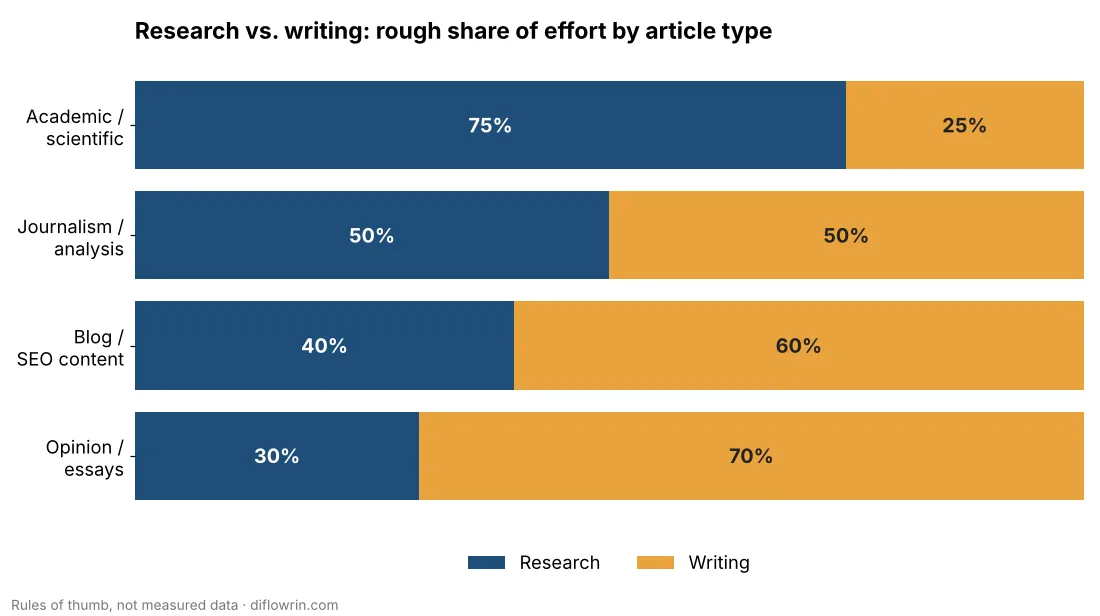
There is no universal ratio, but there are useful rules of thumb:
| Type of article | Rough effort split | Why |
|---|---|---|
| Academic or scientific | 70–80% research | Rigour of sources is the whole point; prose only needs to be clear. |
| Journalism and analysis | About 50/50 | Facts must be airtight, but the story has to hold the reader. |
| Blog and SEO content | Writing-heavy, research-differentiated | Structure drives traffic, but original research is what separates you from generic content. |
| Opinion and essays | Writing and argument lead | The voice carries the piece, yet every factual claim still needs checking. |
One practical rule cuts across all of them: do the research before you know what you will write, and do the writing after you know what you want to say. Many authors start drafting too early and end up hunting for sources that confirm the draft, instead of letting the sources shape it.
Why research is now the weak link
AI writing tools have made the writing side cheap. Anyone can now produce fluent, well-structured prose in seconds. What they have not made cheap is being right. Language models predict plausible text; they do not look facts up. The result is a new and very specific failure: articles that read beautifully and cite papers that do not exist, or real papers that never said what the article claims. We covered how widespread this has become in Fabricated Citations in the AI Era.
Search engines have noticed. On 1 October 2026 Google updated its guidance on generative AI content to say that AI output should be manually fact-checked and reviewed for accuracy before publishing, a review that extends to titles, meta descriptions, structured data and alt text. In other words, when the writing is easy, the checking is where the real effort, and the real competitive advantage, now sits.
That leaves writers with a practical problem. Checking every citation by hand means opening each source, finding the passage, and confirming it supports the sentence attached to it. For a well-sourced article with thirty references, that is an afternoon. Most people skip it.
Doing the research side properly, without losing a week
This is the problem DiFlowRin Research was built for. It is a Windows app that takes a single question and turns it into a written, fully sourced report. Instead of starting with the open web, it goes to academic and primary sources first: OpenAlex, CORE, DOAB, RePEc, clinical-trial registries and SEC filings. It reads full papers rather than abstracts, and when a paper is paywalled it looks for a legal open-access copy and tells you which version it read.
Two parts of its pipeline map directly onto the research weaknesses described above:
- It looks for the other side on purpose. The app searches deliberately for counter-arguments and sets out where experts actually disagree, then sends four adversarial reviewers against its own draft and rewrites whatever they find weak.
- It checks every citation. Each cited sentence is compared against the source note it came from. A sentence its source does not support is corrected or removed.
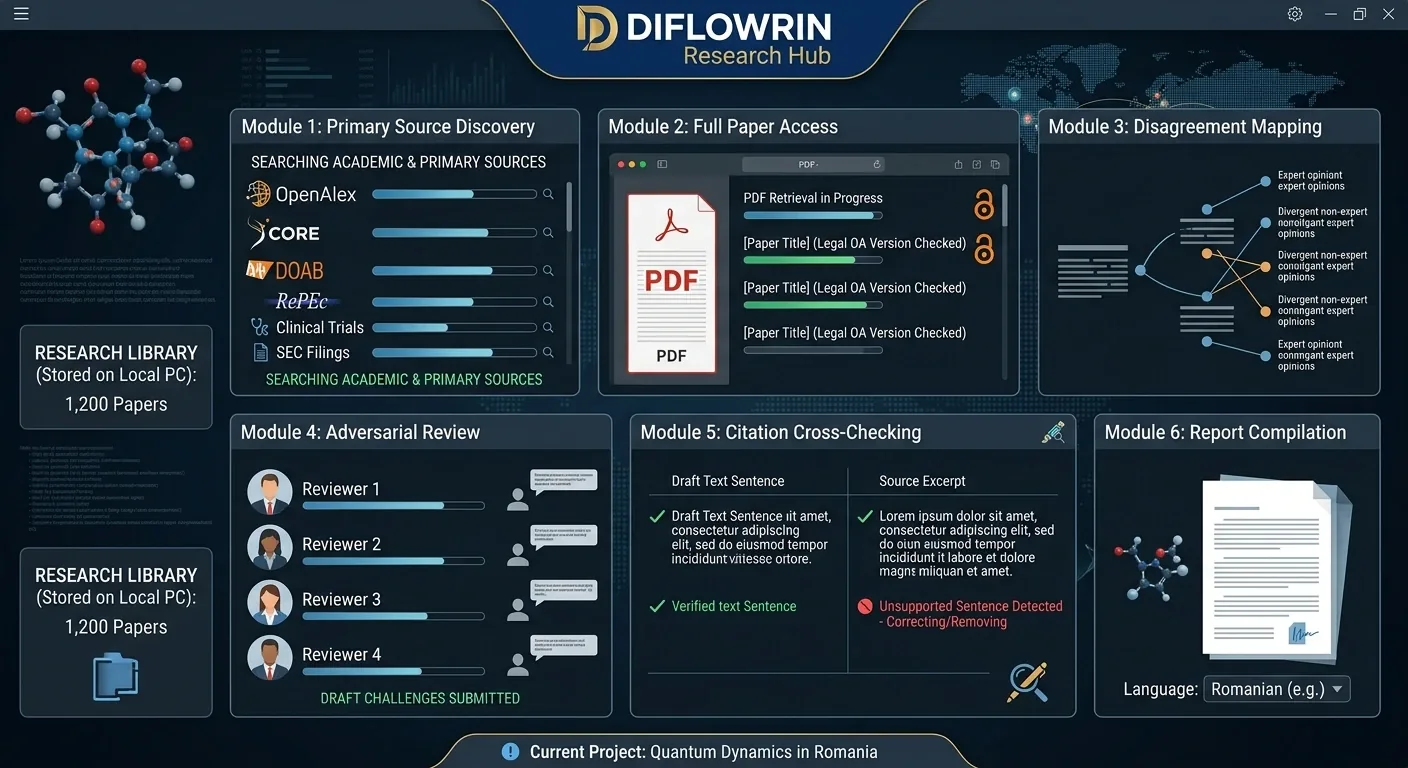
You choose how deep the run goes, from a Short report built on 15–25 sources to a Book-length one built on several hundred, and the report is written in whatever language you asked the question in. Your notes, PDFs and reports stay in a folder on your own PC; there is no account and no DiFlowRin server holding your research.
New: free, detailed citation checking for any text, file or web article
The newest addition to DiFlowRin Research goes beyond the app’s own reports. It can now check the citations in content you already have, in detail and for free:
- Pasted text, such as a draft article, a thesis chapter or an AI-written answer.
- Files you load from your computer.
- Web articles, including pieces you are about to cite or republish.
The checker looks at each reference and asks the questions you would ask if you had the time: does this source exist, and does it actually support the claim attached to it? It is the fact-checking step Google now expects, done in minutes instead of an afternoon.
The feature needs no paid DiFlowRin licence. All you need is one of the following for the AI work:
- An OpenRouter API key. Usage is billed by OpenRouter, per run, and you can pick a low-cost model to keep it cheap.
- Claude Code with a Claude subscription, if you already have one. The app installs Claude Code for you.
Whichever you use, AI usage is billed by your provider, not by DiFlowRin.
A simple workflow that respects both sides
- Research first, with an open mind. Gather primary sources and the strongest counter-arguments before deciding on your angle.
- Decide what you want to say. Write your conclusion in one sentence. If you cannot, you are not ready to draft.
- Write for scanners. Conclusion first, descriptive subheadings, short paragraphs, no marketing fluff.
- Cut ruthlessly. Keep what serves the reader, not everything you found.
- Check every citation before you publish. Manually, or with a tool that compares each claim with its source.
The bottom line
Writing gets an article read. Research gets it trusted, and keeps it trusted. When fluent prose costs almost nothing, the articles that stand out are the ones whose every claim survives a check. If you want to start there, DiFlowRin Research is available for Windows 10 and 11 from the Microsoft Store. The citation checker is free to use with your own OpenRouter key or Claude subscription, and your first full research report is free too.
This article contains AI-generated content, reviewed before publishing. DiFlowRin Research is an independent product and is not affiliated with or endorsed by Anthropic, OpenRouter or Google.