
AI disclosure: This article contains AI-generated content. It is based on a research report produced with DiFlowRin Research, and its facts and sources were reviewed before publishing.
A free LLM API is easy to find and hard to keep. The pages that advertise one change their numbers, retire their models or move the whole offer behind a payment method within months. As of mid-November 2026, about a dozen providers publish a free path to an inference endpoint, but only half of them are true standing free tiers. The rest are monthly credits, one-time quotas, expiring trials or individual models priced at zero.
This guide lists what is actually free, the limits attached to each offer, the aggregators that pool them, and the terms that decide whether a free API survives contact with a real project. Every figure comes from the provider’s own page, a dated tracker or a named third-party review, and is given as published on the date it was checked.
Five kinds of “free”
“Free” here is a billing arrangement, not an absence of cost. Mixing up these five shapes is the most common error in free-API lists:
- Standing free tiers renew on a schedule with no payment method attached: Google AI Studio (Gemini API), Groq, OpenRouter’s
:freemodels, Cloudflare Workers AI and SambaNova. - Monthly credits are a recurring dollar allowance. Vercel’s AI Gateway gives every team account $5 a month.
- One-time quotas are granted once per account and never renew: Alibaba Cloud Model Studio and Scaleway.
- Expiring trials are a small balance that dies on a clock. Cerebras is the clearest case, and Cohere’s free key is an evaluation-only trial.
- $0 model variants are specific models priced at zero on an otherwise paid platform, such as Z.ai’s GLM Flash models.
Two things do not count: open-weight models you download and run yourself are not an API, and a free chat interface is not API access.
The providers, one by one
Google AI Studio (Gemini API)
The widest free model coverage and the fewest published numbers. The pricing page marks Gemini 4 Hydrogen, 3.8 Flash, 3.6 Flash, the Flash-Lite family, the 2.5 and 2.0 Flash models and embeddings as free of charge; Gemini 4 Carbon, Gemini 4 Argon and 3.1 Pro Preview are not. No billing account is needed. Limits are applied per project, reset at midnight Pacific and are shown only inside AI Studio, and Google says they are not guaranteed. The catch is on the plan card itself: on the free plan, content is used to improve Google’s products; on the paid plan, it is not.
Groq
The highest published daily request cap for general-purpose chat models: 30 requests per minute, 1,000 per day, 8,000 tokens per minute and 200,000 tokens per day, per model, on gpt-oss-120b, gpt-oss-20b and qwen3.8-27b. The catalog is small, about ten models, and no longer includes the large Llama or Kimi models older lists show. Limits are per organisation, and no card requirement is stated.
OpenRouter
Both a provider and an aggregator. Its :free models allow 20 requests per minute and 50 per day, rising to 1,000 per day once the account has bought at least $10 of credits. Failed attempts count, extra accounts or keys do not raise the limit, and a negative balance blocks even free models. On 13 November 2026, 15 text models were free, down from 19 on 4 October.
Cloudflare Workers AI
10,000 Neurons a day on the Workers Free plan, resetting at 00:00 UTC, with text generation capped at 300 requests per minute. Depending on the model, that is roughly a few hundred thousand to a couple of million tokens. Watch the exclusions: several current models, including the Kimi K2.6/K2.7, GLM-5.x and DeepSeek V4 families, need a paid billing method. The endpoint is OpenAI-compatible.
SambaNova
With no payment method linked, the Free Tier gives 20 requests per minute, 20 requests per day and 200,000 tokens per day for each listed model. The daily request cap is unusually low, but the models are production-grade: DeepSeek-V3.1, Llama-3.3-70B and gpt-oss-120b, plus previews of DeepSeek-V3.2 and gemma-4-31B-it.
NVIDIA NIM
Free inference for prototyping to any NVIDIA Developer Program member. No card, but phone verification that is not available in every country. A check of the public catalog counted 81 models behind one OpenAI-compatible endpoint, with a practical limit of about 40 requests per minute. NVIDIA frames free use as evaluation, logs inputs and outputs on its hosted endpoints, and rotates models in and out of the catalog.
Z.ai (GLM)
No credit balance, just models priced at zero: GLM-4.7-Flash, GLM-4.5-Flash and GLM-4.6V-Flash cost $0 for input and output. The pricing page publishes no rate limits or data terms, so check the console and the terms before relying on it.
Vercel AI Gateway
$5 of credits a month on every team account, covering a subset of the catalog at lower limits than paid and without Bring Your Own Key. Buying credits moves the team to the paid tier and ends the monthly allowance. Vercel deliberately publishes no numeric limits.
Alibaba Cloud Model Studio
A one-time quota of about 1,000,000 tokens per model, valid for 90 days. Only models in the China (Beijing) region qualify, real-name identity verification is required, and many formerly free models, including DeepSeek, GLM, Kimi and Qwen families, no longer carry a quota for new users. Turn on the “Free Quota Only” switch, or the account starts billing automatically when the quota runs out.
Cohere and Cerebras: trials, not free tiers
Cohere gives a trial key with 1,000 API calls a month and 20 chat requests per minute, and its pricing page states that trial keys may not be used for production or commercial purposes. Cerebras gives $5 of credit that expires after 30 days, requires a verified payment method first, and says plainly that it has no permanently free tier.
Smaller free paths
Four more offers come from secondary sources and were not checked on the providers’ own pages, so verify them before use: Scaleway (one-time quota of up to 1M tokens plus 60 minutes of audio transcription), OVH AI Endpoints (anonymous access at 2 requests per minute per IP per model), Ollama Cloud (a free plan with one concurrent request and 5-hour session caps) and AI Horde (a community-run service with anonymous access at the lowest queue priority).
At a glance
| Provider | Type | Published limits | Card / verification |
|---|---|---|---|
| Google AI Studio | Standing tier | Per project, shown only in AI Studio | No billing account |
| Groq | Standing tier | 30 RPM / 1,000 RPD / 8K TPM / 200K tokens per day, per model | None stated |
| OpenRouter | Standing tier | 20 RPM / 50 RPD; 1,000 RPD after $10 of credits | None for :free |
| Cloudflare Workers AI | Standing tier | 10,000 Neurons/day; 300 RPM text | Cloudflare account |
| SambaNova | Standing tier | 20 RPM / 20 RPD / 200K tokens per day, per model | No payment method |
| NVIDIA NIM | Membership | About 40 RPM | Phone verification |
| Z.ai | $0 models | Not published | Account |
| Vercel AI Gateway | Monthly credit | $5/month; limits unpublished | Vercel account |
| Alibaba Model Studio | One-time quota | About 1M tokens per model, 90 days | Real-name; Beijing region only |
| Cohere | Trial key | 1,000 calls/month; 20 RPM chat | Account |
| Cerebras | Expiring trial | $5 credit, 30 days | Verified payment method |
No longer free, despite what older lists say
- Mistral. Its documentation now says free mode covers Vibe and Studio but not the API; using the API requires billing activation. The only $0 item on its price list is the Moderation endpoint.
- Hugging Face. Free accounts lost their monthly Inference Providers credits on 15 October 2026. Only PRO ($9/month), Team and Enterprise accounts still get an allowance.
- GitHub Models. Fully retired on 30 July 2026: playground, catalog and inference API.
Request caps and token caps bite at different times
The headline numbers are not comparable until you notice that providers count different things: requests per model, requests per account, Neurons, monthly calls or tokens. Which limit you hit first depends on the workload.
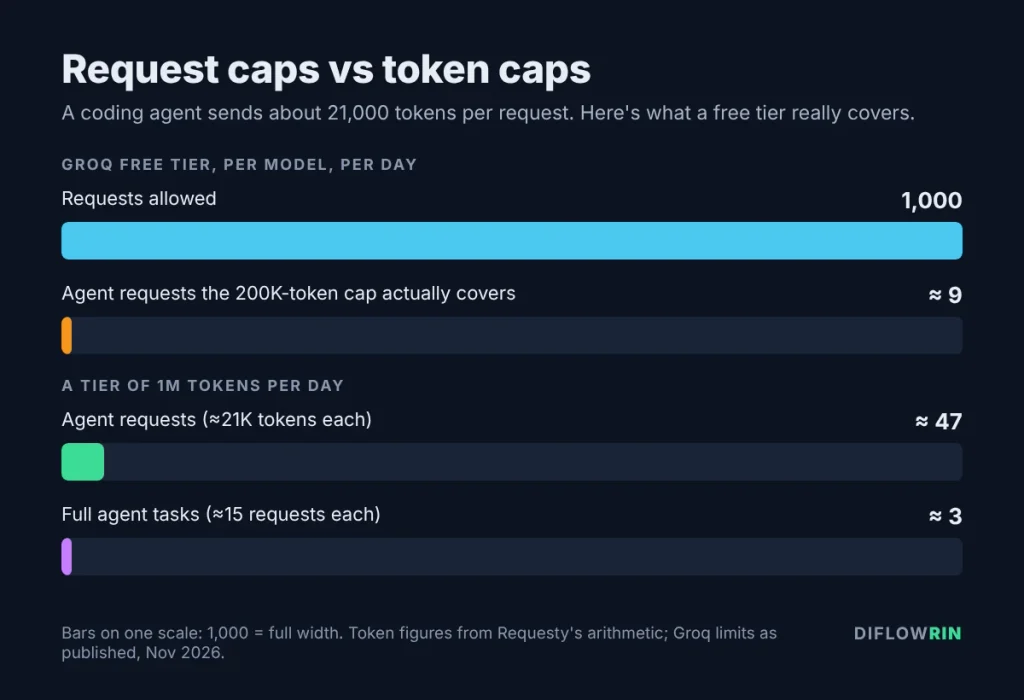
A chat app sends many small requests. A coding agent sends fewer, much larger ones. Requesty’s arithmetic assumes about 21,000 tokens per agent request and about 15 requests per task. On a tier of 1M tokens a day, that is about 47 requests, or roughly three tasks a day.
Groq shows the same trap from the other side. Its 1,000 requests a day look generous, but at 21,000 tokens per request its 200,000 tokens a day cover only about nine agent requests, and a single such request is larger than its whole 8,000-token per-minute allowance. A free tier is a way to test an agent loop, not to run one every day.
Two more details matter for planning. Groq and SambaNova apply their caps per model, so three models give three allowances, while OpenRouter and Cloudflare pool everything at account level. And the clocks differ: Cloudflare resets at midnight UTC, Gemini at midnight Pacific.
Aggregators: one key for many free tiers
An aggregator does not add free capacity. It pools the capacity that already exists behind one endpoint.
FreeLLMAPI is the best-known self-hosted example: an MIT-licensed router you run yourself with your own provider keys. Your apps see one OpenAI-, Anthropic- or Gemini-compatible endpoint, and the router fails over when a key hits its limit. Its README claims 87 providers and about 10.1 billion tokens a month of listed free capacity, but that is the sum of every provider’s allowance, not a personal budget. Its own disclaimer is clear: it is “for personal experimentation and learning, not production.” Quality also tends to dip late in the day as the best models hit their daily caps.
Hosted routers do the same job as a service. OpenRouter is the largest, and Requesty adds a 5% markup on model costs. The lists themselves have aged badly: the once-canonical free-llm-api-resources repository is gone, and even the best dated tracker still lists Mistral’s $10 monthly credit after its own change log flagged it as removed on 8 October.
The terms decide what you can actually do
- Training on your prompts. Google uses free-tier content to improve its products, and human reviewers may read it. NVIDIA logs inputs and outputs on its free endpoints. On OpenRouter it depends on the model, and an account setting decides whether providers that train on your data are used at all.
- Commercial use. Cohere’s trial keys are not for production or commercial use. NVIDIA’s free access is for prototyping; production needs an NVIDIA AI Enterprise licence starting at $4,500 per GPU per year.
- Identity gates. Cerebras wants a verified card, Alibaba wants real-name verification, and NVIDIA’s phone check does not cover every country. These decide whether an offer is reachable from where you are.
- Fair use. One account per provider, no reselling and no sharing your endpoint. Providers enforce limits per organisation, so extra accounts do not help.
FreeLLMAPI’s provider-by-provider review of the terms rates Cohere as “avoid” (its terms forbid personal or household use), NVIDIA, Google and Z.ai as “caution”, and Cloudflare as “ambiguous”. Groq, Cerebras, OpenRouter, Ollama Cloud, OVH and AI Horde are rated “likely acceptable” for a single-user personal proxy. That is a third party’s reading, not legal advice.
Which one should you use?
- Learning and prototyping: NVIDIA NIM for the broadest catalog without a card, Groq for the most predictable daily request budget and fast responses, Google AI Studio when model variety matters most.
- Testing a specific model: SambaNova, which names production models and publishes per-model limits, or Z.ai’s $0 Flash models for GLM.
- Coding agents: expect to evaluate, not to work. Cerebras’s 30-day trial has the most per-minute headroom; Groq’s free caps are too small for agent requests.
- Many providers behind one key: FreeLLMAPI if you self-host for personal use; OpenRouter or Requesty if you want it hosted.
- Anything commercial: the free tier is the wrong tool. Use the paid tier of the same provider.
A checklist before you rely on a free API
- Check the provider’s own page, not a list. The Mistral, Hugging Face and GitHub Models entries still circulating are all wrong.
- Identify the type of offer: standing tier, monthly credit, one-time quota, trial or $0 model.
- Find the limit that binds: requests or tokens, per minute or per day, per model, per key or per organisation.
- Check card and identity requirements.
- Read the data-use and commercial clauses.
- Note the reset time and any expiry date.
- Re-check monthly. Between 4 October and 13 November 2026 alone, Mistral dropped its free API credit, Hugging Face removed free credits, OpenRouter’s free models fell from 19 to 15, and Alibaba withdrew free quotas from a long list of models.
How this guide was researched
This guide is based on a report produced with DiFlowRin Research, a Windows app that turns one question into a written, fully sourced report. It read 33 sources, preferring each provider’s own pricing and rate-limit pages over third-party lists, and checked every cited source again before the report was finished. The report was then reviewed by hand, and four logic errors were corrected before this article was written.
DiFlowRin Research is available for Windows 10 and 11 from the Microsoft Store, and your first full research report is free.
This article contains AI-generated content, reviewed before publishing. Free tiers change often; figures are as published by each provider in November 2026. DiFlowRin Research is an independent product and is not affiliated with or endorsed by any of the providers mentioned.