
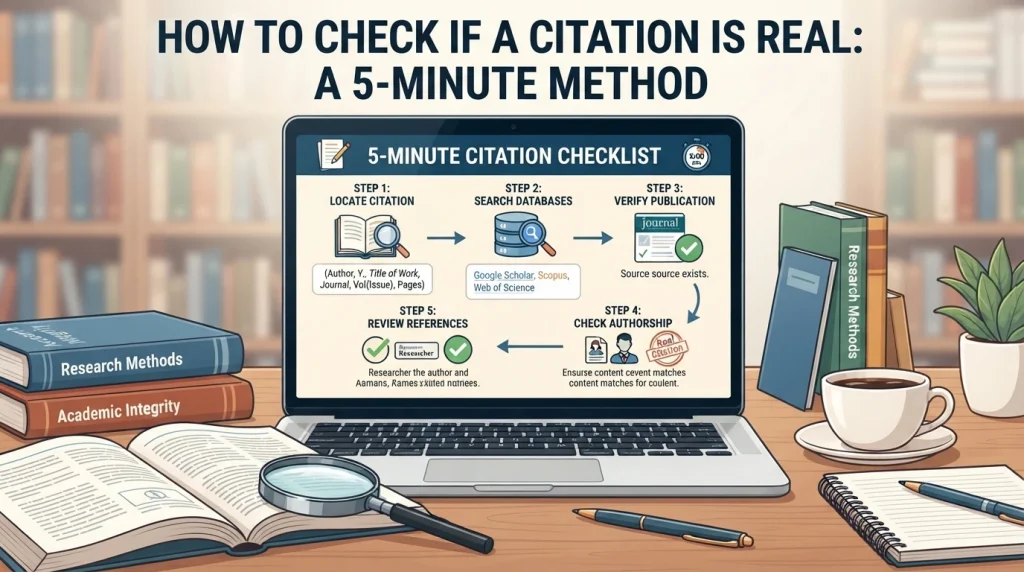
A citation is real when three things are true: the work exists, the details in your reference match that work, and the work says what you cite it for. You can check if a citation is real, on all three counts, in about five minutes per reference. The order matters, though, because the check most people do first, clicking the DOI, is the one AI-invented references are built to pass.
Below is the method step by step, with the free database to use at each step, the red flags that mean “look closer”, and what to do when you have forty references to check instead of one.
Why “it looks right” is not a check
Invented references are not sloppy. In the largest audit so far, published in The Lancet, researchers checked 97 million references from 2.5 million biomedical papers. The share of papers with at least one fabricated citation rose from about 1 in 2,828 in 2023 to 1 in 277 in early 2026. The most common pattern was a plausible title attached to a real identifier. One oncology paper had 18 fabricated references out of 30, each tailored to its narrow topic, attributed to real surgeons in the field, dated 2023 or 2024, and carrying a real PMID or DOI that led to an unrelated paper.
That is why experts miss them. At NeurIPS 2025, more than 100 hallucinated citations reached accepted papers, each paper having been read by three or more reviewers. The full picture, with all the numbers and sources, is in our long read Fabricated Citations in the AI Era. This article stays practical.
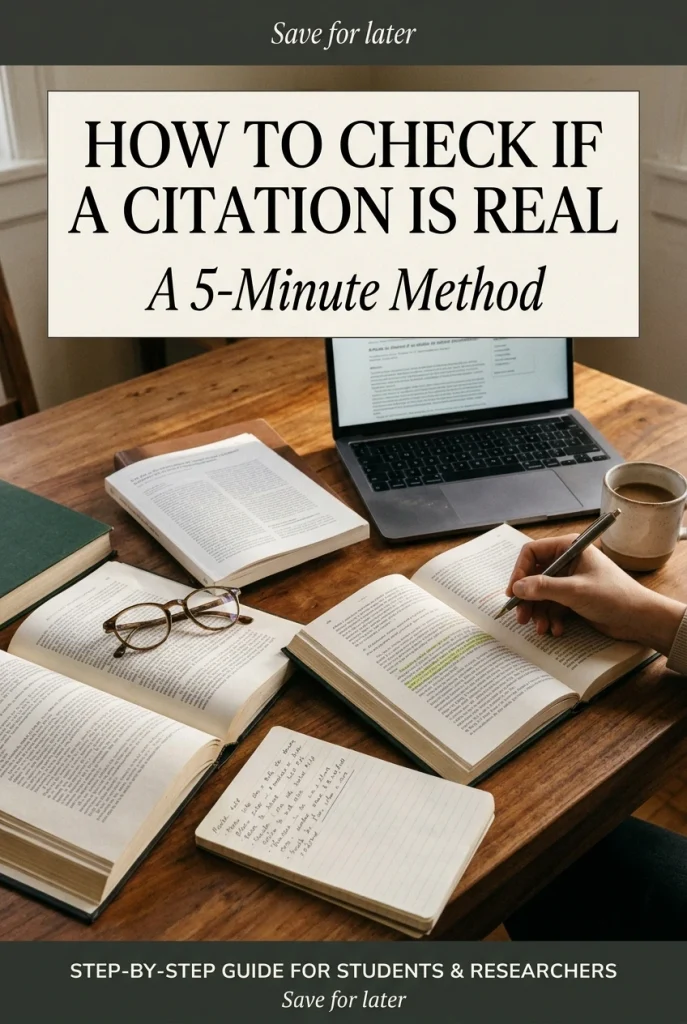
The 5-minute method: five checks, about a minute each
Do them in this order. Each one is cheap, and most invented references fail at step 1 or step 2.
1. Search the exact title in quotes
Copy the title from the reference and search it in quotation marks in Google Scholar. Then search it once more in Crossref Search or OpenAlex, which cover most journal articles with a DOI.
- Exact match, same authors: good sign. Move on to step 2.
- A similar title by other authors, or the same authors with a different title: the reference may be stitched together from pieces of real ones. Treat it as “wrong details” until you prove otherwise.
- Nothing, in any database: a strong warning sign, but not proof yet. Some real sources are not indexed (see When you can’t find it below).
Search the title, not the topic. A topic search always returns something relevant, and that is exactly what makes an invented reference feel real.
2. Open the identifier and compare it with the citation
If the reference has a DOI, put it after https://doi.org/ in your browser. For a PMID, search it in PubMed; for an arXiv ID, open arxiv.org/abs/ followed by the ID. Then read what you land on. Don’t stop at “the page loaded”. Compare the title, first author, year and journal with your citation.
This is the step people get wrong. A working DOI is not proof that a citation is real. In a benchmark of AI-written clinical answers, 99 of 116 DOIs that resolved in PubMed pointed to a different paper from the one the model named. The link works. It just belongs to someone else’s article.
3. Check the journal, volume and pages
If steps 1 and 2 were not conclusive, go to the journal’s own website and open the cited year and volume. Does that issue exist? Do the page numbers fall inside it? Is there an article with that title in the table of contents? Invented references often borrow a real journal name and give it a volume that was never printed, or pages that belong to another article.
4. Check the authors
Look up the first author in Google Scholar, ORCID or OpenAlex. Ask two questions: does this person publish in this field, and does this paper appear in their list of work? AI models like to attach well-known names in a field to papers those people never wrote. A real author is not evidence of a real paper.
5. Check that the source says what you cite it for
A reference can pass every check above and still be a bad citation. Open the abstract, or better the full text, and find the passage that supports your sentence. If you can’t find it within a couple of minutes, either the claim is wrong or the citation is. Real sources cited for things they never said are harder to catch than invented ones, because every database check passes.
Reading the result: four possible outcomes
| Outcome | What it means | What to do |
|---|---|---|
| Confirmed | The work exists and the title, authors, year and journal match. | Keep it. If it carries an important claim, still do step 5. |
| Wrong details | The work exists, but the year, authors, journal or DOI differ from your citation. | Correct the reference from the real record. If the DOI belongs to a completely different paper, treat the whole reference as suspect. |
| Not found | No match in any database. | Invented references end up here, but so do real sources that are not indexed. Do the checks in the next section before deciding. |
| Web source | A report, policy, news story or blog post, which academic databases don’t cover. | Open the link. If it is dead, look for a saved copy in the Wayback Machine. A link that leads nowhere and was never archived is a red flag. |
When you can’t find it: real sources that hide well
“Not found” does not mean “fake”. Some real sources are simply missing from the big databases:
- Older books and book chapters. Search the ISBN or the title in WorldCat or Open Library. Be careful here, though: book chapters are also the format AI invents most. In one test, 70% of the book chapters GPT-4 cited were fabricated.
- Local or national journals that don’t register DOIs. Check the journal’s own archive.
- Reports, theses and conference posters. Check the repository of the institution that published them.
- Sources in other languages. Search the title in its original language, not a translation.
If you still find nothing after all that, don’t cite it. Ask whoever gave you the reference for a copy. If they can’t produce one, you have your answer.
Red flags at a glance
| What you notice | What it often means |
|---|---|
| The DOI works but opens a different title | A real identifier attached to an invented paper, the most common AI pattern |
| A well-known author, but the paper isn’t in their publication list | A real name attached to a paper that doesn’t exist |
| The title fits your argument perfectly, yet you can’t find anyone else citing it | A title generated to match the prompt |
| The journal exists, but the volume or pages don’t match the year | A borrowed journal name |
| A recent year, a very narrow topic and no trace anywhere | The typical shape of a fabricated reference |
| A dead link that was never archived | An invented web source |
| A book chapter with no ISBN and no editors | The format AI fabricates most often |
One red flag is a reason to check, not a verdict. Two or more on the same reference, and it probably doesn’t exist.
Checking a whole bibliography in seconds
Five minutes per reference is fine for one suspicious citation. For a thesis chapter with 40 references, it is more than three hours. That is why most people check two or three and hope for the best.
I built Fake Citation Detector, a free extension for Chrome and Edge, to do steps 1 to 4 for a whole list at once. Paste up to 100 references into the side panel, or select one citation on any page and choose Check this reference from the right-click menu. The extension searches each reference by DOI, ISBN, arXiv or PubMed ID, then by title and authors in Crossref, OpenAlex, DataCite, PubMed, Open Library and Semantic Scholar. Every reference gets one of the four outcomes above, with the record it found and links so you can check it yourself.
- Wrong details are shown side by side: the cited year, journal, authors or DOI next to the real one. One click copies the corrected reference in APA, MLA, Chicago, Harvard, IEEE, Vancouver or ISO 690.
- Web sources are opened and compared with your citation, and dead links are looked up in the Internet Archive.
- Reports export as TXT or CSV, which is useful for supervisors, teachers and editors.
In our October 2026 test on 397 references in seven citation styles, it marked none of 222 real references as “not confirmed”, caught all 120 AI-invented references, and caught 53 of 55 real references that had one detail deliberately changed. There is no account and no server of ours: your browser talks directly to the public databases.
Two honest limits. First, the extension checks that a source exists and that its details match; it does not do step 5. Comparing each cited sentence with the text of its source is what DiFlowRin Research, a Windows app by the same author, does. Second, “not confirmed” is a reason to look closer, never proof that a reference is fake. If you publish on WordPress, Verified References runs the same kind of check on a post’s sources inside the block editor, before you hit publish.
Frequently asked questions
Can I just ask ChatGPT whether a citation is real?
Not reliably. Without a database lookup, a chatbot answers from memory, which is how invented references are produced in the first place. Even with web search switched on, general-purpose models scored below a dedicated retrieval-based checker in a 2026 citation-detection benchmark. Use a database lookup instead.
If the DOI works, is the citation real?
Not necessarily. Open the DOI and check that the title, authors and year match your citation. A working DOI that leads to a different paper is one of the most common signs of an invented reference.
How long does it take to check if a citation is real?
About five minutes for all five checks. Most invented references fail in the first two, so you often know within a minute or two. For long lists, an automated checker does steps 1 to 4 in seconds per reference.
What should I do with a reference I can’t verify?
Remove it, or replace it with a source you have actually read. A reference you couldn’t find is one your reader, reviewer or examiner won’t find either.
The short version
- Search the exact title in quotes.
- Open the DOI or ID and confirm it is the same paper.
- Check that the journal issue and pages exist.
- Check that the author really wrote it.
- Check that the source says what you cite it for.
Do this for the one citation you’re unsure about. For the whole list, let Fake Citation Detector do the first four checks and spend your five minutes on the references it flags.
This article contains AI-generated content, reviewed before publishing. Fake Citation Detector, DiFlowRin Research and Verified References are made by the author of this blog. They use data from Crossref, OpenAlex, DataCite, PubMed, Open Library and Semantic Scholar and are not affiliated with these services.